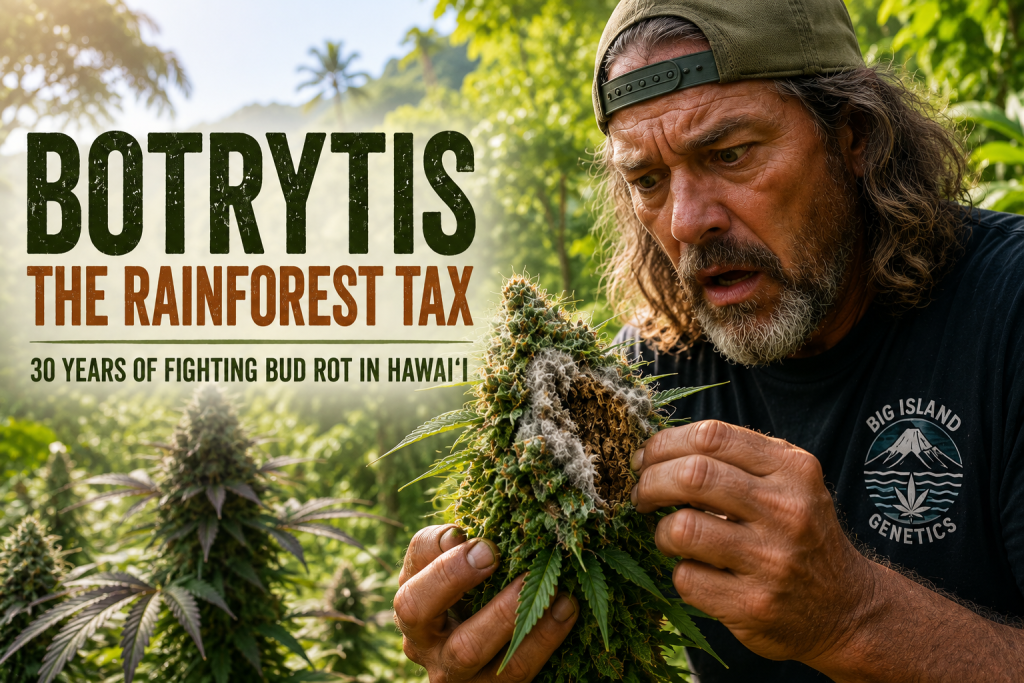
Why Is Botrytis the Tax You Pay for Growing Cannabis in the Hawaiian Rainforest?
Because you live in a rainforest. That is the whole answer. Everything else is just the bill itemized.
Botrytis cinerea — gray mold, bud rot, the thing that turns your best cola into a fistful of wet garbage two weeks before harvest — does not show up in Puna because you did something wrong. It shows up because you chose to grow the most humidity-sensitive crop on earth in one of the wettest places on earth. Nobody told you not to. The Professor certainly did not tell you not to. He moved here and did the same thing. We are all in this together, braddah, standing over our respective trash cans, taking our respective moments of silence.
The fungus was here before you arrived. It will be here long after you are gone. It does not care about your harvest timeline, your years of experience, or how good the last run was. It cares about moisture and warmth and dead plant tissue, and Puna provides all three in unlimited quantities every single month of the year. Your job is not to eliminate it. Your job is to make your garden a less attractive destination than the one next door. That is the whole game. Welcome to it.
—
What Botrytis Actually Is and Why It Is Already Inside Your Plant
Most growers picture botrytis as something that lands on the outside of the bud and works its way in. Like it is politely knocking on the front door. It is not knocking. It does not knock. Botrytis cinerea is a necrotrophic fungal pathogen — it feeds on dying and dead plant tissue — and it gets in through wounds, through dead leaves left on the stem, through the natural openings in plant tissue, and through the dense airless interior of a cola that has been trapping moisture for six weeks of flowering. It was already inside while you were out there admiring the trichomes and feeling good about yourself.
By the time you see anything on the outside — the white or gray fuzz, the cola that feels slightly wrong when you squeeze it, the brown tissue you notice mid-trim — the mycelium has been running through the interior of that bud for days already. What you see on the outside is the fungus finishing its work, not starting it. You are not catching it early. You are finding the obituary.
The Professor learned this the hard way. The Professor learned most things the hard way. Thirty years is a long time to keep being surprised by the same fungus, and yet here we are.
—
Let’s Be Real About What Kind of Wet We Are Actually Talking About
Eighty percent humidity sounds like a bad week in Florida. In Upper Puna it is a Tuesday. Mountain View and the surrounding area runs seventy-five to a hundred and twenty-five inches of rainfall annually as a baseline — not in a bad year, as a regular year. Hilo, just down the road, is the wettest city in the United States at around a hundred and thirty inches per year. And unlike places where wet season means something specific and then ends on schedule, in Puna any month of the year can decide to become the wet season with zero notice and zero apology. January can be the wet season. July can be the wet season. The sky does not check a calendar out here.
The Professor has watched it rain for a full week straight without stopping. Not slowing down. Not breaking for an afternoon. A solid week of continuous rain with humidity sitting so high the air basically becomes water you have to walk through. Crispy dry weed left out on a screen for two hours goes soft. Stems that snapped clean in the morning bend by afternoon. The outside air does not just raise your humidity numbers. It reaches in and reclaims your harvest like it was borrowed property you forgot to return.
Now. The growers in California, Oregon, and Washington dealing with botrytis — the Professor has sympathy for them. He does. One storm system rolls through in late September or early October right before harvest, wrecks their outdoor crop, and they think they understand what fighting mold means. They do not understand what fighting mold means, braddah. They are dealing with a bad week. We are dealing with the entire year. They get one storm. We get the whole Pacific. And most of them are not running genetics that were bred for any of it. They are running dense indoor strains that have never seen a rainforest in their lives and they are surprised when a little October rain does what it does. Plant something that was built for wet. Stop being surprised by water.
—
The Real First Line of Defense Is What You Planted
The Professor should have led with this. Before the airflow advice, before the defoliation schedule, before the hydrogen peroxide, before any of it — the single most important decision you make about botrytis in a tropical garden is what genetics you put in the ground. Everything else is managing the consequences of that choice.
Dense, rock-hard, tightly packed indica-dominant structure is a botrytis machine in tropical conditions. The same genetics that produce jaw-dropping bag appeal in a dry climate produce jaw-dropping losses in a wet one. The Professor has run those genetics out here. The Professor has stood over the results. Hammajang does not begin to describe it. The mold does not care how much you paid for those seeds or how good they looked in the catalog.
Open, airy sativa structure — the elongated, loose, well-spaced cola that lets air actually move through the flower itself — is what survives on the island. Not because it looks better. Because moisture does not get trapped inside it the way it does in a rock-hard dense nug. Thirty years of selection pressure applied by the Hawaiian rainforest to every garden in it has been making this exact point over and over and the growers who listened are still growing. The ones who kept running dense indoor genetics outdoors here have made peace with losing a third of their garden every season. Sort of.
—
Why Hawaiian Genetics Carry This Resistance in Their Blood
Here is the history that most people do not know and it is worth knowing.
The Hawaiian strains that built the islands’ reputation — Kauai Electric, Puna Budder, Maui Wowie — did not arrive here fully formed. They were built. Starting in the sixties and seventies, genetics from Vietnam, Thailand, and Cambodia came to Hawaii through GIs returning from Southeast Asia who had encountered something they had never smoked before and were smart enough to bring seeds home. Those Southeast Asian landraces crossed with what was already being grown on the islands and produced the Hawaiian genetics that would go on to define a generation of cannabis culture worldwide.
Here is what those Southeast Asian genetics brought with them beyond the potency and the high that blew everybody’s mind: thousands of years of adaptation to hot, wet, tropical conditions. Thai landraces, Vietnamese genetics, Cambodian sativas — these plants evolved in climates that make Puna look manageable on a good day. They developed airy, elongated, loosely structured flower specifically because their environment demanded it. Dense buds did not survive where they came from. Only the open ones did. That selection pressure ran for thousands of years before anyone brought a seed to Hawaii, and it is still in those genetics today.
Kauai Electric. Puna Budder. Maui Wowie. These strains carry that Southeast Asian mold resistance in their lineage. That is not an accident and it is not marketing. It is the result of the right genetics meeting the right islands and proving themselves over decades of real growing in real conditions. Big Island Genetics has been actively breeding for increased mold resistance for the last decade, working with and beyond these foundational Hawaiian genetics specifically because these islands demand it. That work is ongoing and the results are showing up in the garden where it counts.
And here is another piece worth understanding: some of the most resin-heavy genetics on earth come from places soaking wet with moisture. Hindu Kush landraces grow at high elevation in Central Asia surrounded by clouds, cold, and humidity. Those plants developed serious resin production as a direct biological response to harsh wet conditions — the resin coat is armor, built over thousands of years by an environment that was trying to kill the plant. That resilience carried into their descendants.
Then there is the Haze lineage, which most people talk about without knowing where it actually came from. The Haze Brothers were growers in Santa Cruz, California in the early seventies who gathered several different Mexican landrace sativas — plants that had been growing for generations in hot, humid, equatorial conditions — and crossed them together. That is what Haze is. Same story, different continent: tropical genetics hardened by wet conditions over generations. That is why Haze-dominant strains keep showing up on mold resistance lists. It is not a coincidence. It is what the lineage was built from. Every strain carrying significant Haze genetics is carrying a piece of that Mexican landrace tropical adaptation — the same fundamental story as the Southeast Asian genetics that built the Hawaiian strains. Hot. Wet. Survived anyway. Passed it on.
—
The Science Starting to Catch Up With What the Plant Already Figured Out
Here is something universities are just beginning to study that experienced tropical growers have known for years through observation: the resin coat on a cannabis plant may not just be there to make concentrates. It may be doing real biological work against pathogens.
Alpha-pinene and beta-pinene — the compounds responsible for that sharp piney aroma in certain cultivars — have documented antifungal properties. They disrupt fungal cell wall function and compromise cell membrane integrity. Myrcene and limonene show similar antifungal activity in research settings. The exact mechanism by which the plant’s resin production interacts with botrytis specifically is still being actively studied — this is not settled science yet — but the direction of the findings is consistent: plants with robust resin production and specific aromatic compounds appear to have a measurable advantage against fungal pressure.
In plain language: a plant that smells a certain way — piney, sharp, deeply resinous — may be carrying chemistry that makes it harder for botrytis to get a foothold. The smell is not just the smell. It may be the plant’s immune system doing its job out loud. The Professor finds this deeply satisfying after thirty years of noticing that certain plants in the garden just seemed to handle wet conditions better than others and not being able to fully explain why. The science is catching up to what the garden already knew. Shoots.
—
Strains With a Real Reputation for Handling Humidity
No strain is immune. The Professor wants to be clear about that before listing anything. Mold resistant means harder to kill, not impossible to kill. If the conditions are bad enough, everything is vulnerable. What you are selecting for is a better chance, not a guarantee. With that said — these genetics have earned their reputations.
The Hawaiian classics — Kauai Electric, Puna Budder, Maui Wowie — are the starting point for anyone growing on the island. Proven in this specific climate over decades. The Southeast Asian lineage that built their structure was selected for exactly this environment. If you can get your hands on genetics with real Hawaiian lineage rather than something that just has a Hawaiian name slapped on it by a seed company in Amsterdam, that is where you start.
Jack Herer has a genuine mold and mildew resistance reputation built on its Haze lineage — which traces straight back to Mexican landrace tropicals. Open airy structure, documented resistance, likes hot climates. This one is real and the track record backs it up.
Durban Poison is a South African landrace with documented resilience in humid conditions. Open structure, fast finishing, landrace-tested toughness going back generations. Some growers in extreme wet climates have had mixed results with it late in the season so it is not bulletproof, but the genetics are solid and it makes an excellent parent for breeding projects aimed at mold resistance.
Amnesia Haze carries Thai, Hawaiian, and Afghani lineage and shows it. Fluffy open colas that let air move through, robust against fungal pressure in damp environments. The combination of tropical sativa genetics with Afghani backbone gives it resilience in more than one direction.
White Widow has a nearly mythical reputation for mold resistance and the Professor has been hearing about it for thirty years. Even that one has its limits on the island. The Professor has seen White Widow genetics take a serious hit in Puna during a bad wet stretch and it was not pretty. Respect the reputation. Do not worship it. The island will humble any strain if you give it enough rain and enough time.
On the newer end, F1 hybrid breeding programs have produced varieties like Hyperion F1 and Apollo F1 with specifically engineered botrytis resistance — genuine lab-verified resistance bred into the genetics rather than just observed by growers over time. This is where mold resistance breeding is heading and it is worth watching.
Bangi Haze — a Congolese-Nepalese cross bred specifically in rainy cold Galicia, Spain — has documented resistance to botrytis and cold snaps, open branching that welcomes airflow deep into the canopy, and a track record in soggy conditions that very few strains can match. Not a household name out here. Worth knowing about.
Start with genetics that have proven themselves where you are growing. A list from the internet is a starting point. Thirty years of growing in volcanic soil on the island is a different kind of data set entirely. Big Island Genetics has that data set. That is why we are here.
—
What Actually Prevents It in a Tropical Outdoor Garden
Most botrytis prevention advice assumes you have a controlled indoor environment. Keep humidity below fifty percent. The Professor will pause here and let that land. Below fifty percent. On the island. Where it rains for a week straight and the baseline runs in the eighties. That advice was written for someone else. The principles underneath it are sound but the tools available to an outdoor grower in the Hawaiian rainforest are specific and you need to know which ones actually apply here.
Airflow first, always. Moving air is hostile to botrytis in a way that still air is never going to be. You cannot control when the trade wind shows up but you can control your canopy. A garden where air moves freely between plants — properly spaced, branches not touching, opened up so the interior of each plant actually breathes — is a fundamentally different environment from a crowded tangle where everything is pressed together and moisture sits still. Moving air removes the surface moisture spores need to germinate. Give it somewhere to go. If your garden looks like a solid green wall from outside, that is not a garden. That is a mold incubator with good intentions.
Strip the dead and dying tissue consistently through the last four weeks of flower. Every yellowing fan leaf, every brown petiole left on the stem, every piece of dying plant material still attached is a welcome mat. Botrytis colonizes dead tissue first. Remove it, get it out of the garden entirely — not on the ground at the base of the plant, not in a pile nearby, gone — and you are removing the easiest entry points the fungus has.
Inspect every plant every single day in the last two weeks before harvest. Not a walk-through. Hands on the plant, branches turned, colas opened up gently and examined from the inside. The five minutes you spend finding it on Tuesday is the difference between losing one branch and losing everything. The Professor has skipped this inspection because he was tired and figured things were probably fine. Things were not fine. Things were barber pole fine, which is not fine at all.
—
A Note on Greenhouses in the Tropics
Here is something the Professor has observed directly and it goes against what most people assume. You would think a greenhouse protects your plants from botrytis. You would think keeping the rain off the buds is a good thing. And in most climates that is exactly right. On the island in a humid tropical environment the story gets more complicated.
Outside plants get rained on. Regularly. That rain is actually washing dust, dirt, bug frass, airborne spore load, and all the accumulated debris off the surface of the buds on a consistent basis. The rain is doing a cleaning job you did not know you needed.
Greenhouse plants in a tropical humid environment never get that rinse. Everything that lands on the surface of the bud — dust, frass, spores, whatever the air is carrying that day — just sits there in the ambient moisture and accumulates. Never washed off. Never disturbed. Just sitting on the flower in warm wet air day after day.
The Professor has run the same strain side by side — some plants outside, some right next door in the greenhouse — in conditions where it was raining regularly on the outdoor plants. The outdoor plants had some mold, a little botrytis here and there, manageable. The greenhouse plants that were never getting rained on blew up. Same genetics, same garden, right next to each other. The difference was the rain washing the outside plants and the greenhouse trapping everything on the inside ones.
This does not mean greenhouses are wrong for the island. It means if you are running a greenhouse in a tropical humid environment you need to think seriously about airflow, about keeping the inside environment genuinely dry rather than just covered, and about what is accumulating on the surface of your flower that is never getting washed away. A greenhouse that is simply a tent with a roof and ambient tropical air inside is not a controlled environment. It is a warm wet enclosed space. And you already know what thrives in a warm wet enclosed space.
—
How It Spreads and Why Cutting It Out Is Not the Whole Answer
You find it. White fuzz tucked inside a cola, soft brown tissue mid-trim, something that does not look right when you pull the bud open. You cut it off. Clean cut. You feel like a surgeon. You feel like you handled it.
You did not handle it. You found the part you could see. The part you cannot see has been traveling up and down the inside of that stem for days already. Growers out here call it barber pole — the rot spiraling through the cola like the stripe on the sign outside the shop. Every day you do not get the conditions under control, another stripe. You cut Tuesday’s patch and Thursday’s patch is already started somewhere you have not looked yet.
It also moves through the air. Cut into infected tissue and you release spores. One infected cola handled carelessly in a garden is three infected colas by the next morning. The Professor has watched this happen in real time and it is the kind of thing that changes how carefully you handle a pair of scissors for the rest of your life.
The protocol when you find it: do not cut infected material while standing in the garden. Remove the branch from the space first. Take it outside. Cut well past where you can see the infection — two inches minimum into clean tissue and that is a starting point not a finish line. Isopropyl alcohol on the scissors between every single cut. Not between plants. Between cuts. Because the scissors carry it and they will introduce it to every clean bud they touch afterward if you let them.
—
The Hidden Botrytis Trigger Nobody Talks About: The Caterpillar
Here is something most botrytis posts never mention because most botrytis posts are written by people who have not spent enough time in a tropical garden watching what actually happens.
A lot of what looks like botrytis starting randomly in the middle of a healthy bud is not random at all. It started with a caterpillar. A tiny one. The kind you will never see unless you are specifically looking for it — the larva of a moth that came out on a warm humid night, found your flower, and laid eggs directly inside the bud. The egg hatches. The caterpillar goes in. It eats. It burrows. It leaves behind frass — caterpillar droppings — along with chewed plant material and damaged tissue right in the heart of your cola. Then it evacuates when conditions change. What it left behind is a perfect little starter kit for botrytis: dead organic matter, moisture, warmth, delivered directly to the most vulnerable and least ventilated part of your flower, wrapped in bud so you cannot see any of it from the outside.
You are not dealing with mold that found a wet bud. You are dealing with mold that found a wet bud that a caterpillar pre-damaged and fertilized for it. The fungus did not have to work at all. The caterpillar did the setup and the botrytis moved right in. By the time you notice the rot from the outside, the caterpillar has been gone for days and the barber pole has been running ever since.
This is not a rare situation on the island. This is choke common. The Professor has found caterpillar damage at the origin of more botrytis outbreaks than he can count and has stopped being surprised by it. What he has done is figure out how to intercept them before they get inside. And that starts with understanding when the moths that produce them are most active.
—
The Full Moon Protocol: Three Days Before, Every Time
The moths that lay eggs on your buds are not out every night in equal numbers. They follow the lunar cycle. Peak moth activity — peak egg laying, peak damage — happens around the full moon when the nights are brightest. The Professor has watched this pattern for thirty years in Upper Puna and it is not folklore. It is a real, observable, repeatable phenomenon that shows up season after season in the same way.
Three days before the full moon. That is when you spray. Every month through flowering. Not when you see damage. Before you see damage. Because by the time you see damage the eggs have already hatched, the caterpillars are already inside the bud eating and leaving frass behind, and you are already behind. You are not spraying the problem you can see. You are intercepting the problem that is coming.
What you spray is BT — Bacillus thuringiensis, sold under brand names like Monterey BT and Thuricide. It is a naturally occurring soil bacteria completely specific to caterpillars and worm-type insects. When a caterpillar eats plant tissue that has been sprayed with BT, the bacteria destroys its digestive system. It stops feeding almost immediately and dies within a few days. BT does not affect bees, beneficial insects, birds, humans, or anything else. It is OMRI listed for organic production and safe to use all the way up to the day of harvest. Apply in the evening to protect bees that are active during daylight hours.
Spinosad is the other tool in this rotation. Also organic, also derived from naturally occurring soil bacteria, also approved for use up to harvest. Spinosad hits a broader range of insects than BT — caterpillars, thrips, and others — and works as both a contact killer and an ingestion killer. Alternate BT and Spinosad through the flowering season, three days before each full moon, because rotating products prevents insects from building tolerance to either one. Both break down quickly in sunlight and do not accumulate in soil or plant tissue. Mix Spinosad fresh each time — it degrades quickly once mixed with water and loses effectiveness if you let it sit.
Apply in the evening. Cover the buds thoroughly but do not drench. You are putting a protective coating on the surface that the next generation of larvae will encounter when they hatch. You are not reacting to the problem. You are preventing it one full moon at a time.
The Professor sprays three days before the full moon every single month through flowering without exception. Not when it looks bad. Not when he finds damage. Every month on schedule because the moths do not take a month off and neither does he. Fifteen minutes of work once a month that has saved more harvests than any other single practice in the garden. That is akamai. That is the move.
—
The Hydrogen Peroxide Move
The Professor has a friend who sprays his plants with a mild solution of hydrogen peroxide and water during late flowering. Light mist, directly on the buds, any time conditions get bad or after he cuts out any infected tissue, sometimes just as a daily preventive when the humidity has been sitting at ninety percent for a week straight. Some people hear this and get nervous. Wrong reaction.
Here is the science because the science is simple and satisfying. Hydrogen peroxide — H2O2 — is chemically almost identical to water except it has one extra oxygen atom. That extra oxygen is what kills fungi. When it contacts botrytis spores on the surface of your flower it oxidizes them — burns through the fungal cell wall and destroys the spore before it gets started. Then it breaks down completely into water and oxygen. No residue. No chemical trace. Nothing left on the flower that affects how it smokes or tastes or smells. It does the work and then it disappears like it was never there. The Professor appreciates a tool that cleans up after itself.
The dilution: 3% hydrogen peroxide — standard pharmacy stuff, cheap, available everywhere — mixed one part peroxide to three parts water. That ratio. Not stronger. Stronger damages trichomes and plant tissue and that is not the goal. At the right dilution it is hostile to the fungus and respectful of the flower.
After cutting out any infected tissue, spray the cut area and the surrounding colas immediately. Cutting releases spores and the spray knocks them down before they find a new home. Clean the scissors with isopropyl alcohol between cuts, then spray, then move. You are doing surgery out there. Act like it.
Use it preventively after heavy rain, on high humidity mornings, whenever the conditions have been perfect for spore germination and you want to give those spores a less welcoming surface to land on. Apply early in the day so it has time to evaporate before nightfall. Light mist. Not a soaking.
Is it a cure? No. Nothing cures botrytis once the mycelium is running through the interior of a cola. The hydrogen peroxide works on the surface — on spores that have landed but not yet dug in, on exposed tissue after a surgical cut, on the exterior of buds that are at risk but still clean. It buys time. On the island, time is what you are always buying. Any legitimate tool that buys you another clean day is worth using. The Professor’s friend does it daily when things get serious. That is more work. Nobody said growing in the rainforest was supposed to be easy, braddah.
—
Timing Is Everything. Or As the Professor Says, Timing Is Not Just Another City in China.
Here is the conversation nobody wants to have about botrytis on the island: sometimes the right move is to cut early. Not what a connoisseur wants to hear. Not what the Professor wants to say. But real.
Sunny dry weather is the best botrytis treatment that exists. No humidity, no mold pressure, plants finishing in actual sun — that is the dream out here and it does happen. Not as often as anyone would like, but when it comes you know it and you are grateful for every single day of it. When the weather cooperates and you get a genuine dry stretch at the end of the season, plants finish the way they are supposed to finish. The bracts get fat and swollen. The flower feels complete. The whole plant tells you it has arrived and you cut it at the right moment and everything is the way it is supposed to be. That harvest exists on the island. The Professor has had it. It is worth growing for.
But when the weather does not cooperate — any month, any week, no warning — you are making a different calculation every day. The clean buds are getting heavier and more mature. The mold you cut out yesterday has a cousin somewhere you have not found yet. The barber pole is moving in one direction and the harvest window is opening in the other and you are standing in the middle doing the math. Every day you wait you get more from the clean plants and risk more from the ones that are not. There is no formula for it. There is only judgment built from seasons of making this exact call and sometimes getting it wrong.
Cutting early is not failure. Cutting early is a decision made by someone who has done the math and chosen to save what can be saved. A plant harvested before full maturity is still a plant. Still resin. Still value. A plant left too long in the wrong conditions is a trash can story. One of those outcomes is recoverable. The other is not.
And here is the thing worth knowing if you are leaning toward an early cut: a younger harvest is not a lesser product. A plant harvested before full ripening has a higher percentage of THC that has not yet converted to other cannabinoids. Different effect — more energetic, more cerebral — than a fully ripened plant. Neither is wrong. They are different things. And if you are working with concentrates, an early harvest with strong resin output is absolutely a viable product. The resin is there. The extraction will find it. You are not throwing away medicine. You are harvesting it at a different point on the curve than you planned, and you are making something real out of it instead of watching it go soft in the rain.
Cut when you have to. Save what you can. Make it into something. That is island growing. Always has been.
—
## The Sealed Greenhouse and What Comes After It
If you have the resources, a sealed greenhouse changes the equation significantly. Climate control at night — when temperatures drop and humidity spikes and botrytis is most active — dramatically reduces the window the mold has to work in. A hermetically sealed structure with controlled airflow means you are not fighting the outside air anymore. You are managing your own environment inside it. That costs money. It is also why gardens running sealed greenhouses on the island consistently produce cleaner harvests than open-air grows when everything is done right.
But as the Professor just explained in the greenhouse section — a greenhouse that is simply a covered structure with ambient tropical air moving through it is not a controlled environment. It is a warm enclosed space that never gets rained on. If you are going to run a greenhouse on the island, seal it properly and control the air inside it or you may find yourself worse off than the garden next door that is getting rained on every afternoon.
Most people in Upper Puna are off-grid. A sealed greenhouse with climate control running every night is a real expense and not everyone can do it. You work with what you have, apply everything in this post as well as you can, and accept that the island will always have a vote no matter how good your setup is.
For those who want to go further — and the Professor means significantly further, next-generation further — there are approaches being developed specifically for eliminating botrytis and other pathogens from sealed growing environments without chemicals, without residue, and without compromise to the flower. The Professor has a patent-pending approach in this space. It is not ready for a blog post today. When it is, you will find it here at Big Island Genetics. It is the kind of thing that changes the conversation entirely.
That is all that gets said about it today. Shoots.
—
Do Not Smoke It. Seriously, Braddah.
This needs saying because people do it and it needs to stop. Botrytis cinerea produces mycotoxins and allergens. Smoking or vaporizing infected cannabis sends those directly into your lungs. There is a documented medical condition called Winegrower’s Lung linked to chronic botrytis inhalation. The Professor is not your doctor and is not giving medical advice. He is telling you that thirty years in this garden has produced one very clear rule about moldy flower: it goes in the trash, not in the bowl.
It does not matter how close to harvest it was. It does not matter how much of the rest of the plant looks clean. It does not matter how good the season was up until that moment. Moldy weed is not a product. It is a loss you take and move on from.
And when you throw it out — do it outside. Open that bag outside. The cloud of spores that comes out of a bag of botrytis when you break the seal is not something you want in your dry room, your living space, or your lungs. Take it outside, open it outside, and let the island have it back. It came from out there anyway.
—
The Real Lesson After Thirty Years
Botrytis is not a failure of vigilance. It is the cost of growing in the most biologically active environment on earth. The Hawaiian rainforest does not give you easy grows. It gives you volcanic soil that produces world-class flower and a humidity level that tries to take it back every single season. That is the deal. That has always been the deal.
The growers who win out here are not the ones who figured out how to eliminate botrytis. Nobody eliminates botrytis on the island. The growers who win are the ones who select genetics the rainforest can work with, manage their canopy so the air can move, spray three days before the full moon every single month, catch problems early enough that they only lose a branch instead of a harvest, and know when to cut and move on instead of waiting for a perfect finish that the weather has already decided is not coming this season.
That is the tax. You pay it every year. You get better at keeping the bill manageable. You never stop paying it entirely.