Why Does Puna Budder Have a Reputation That Outlasted the Generation That Made It?
Because the real thing is that good. That is the short answer and it has been the answer for fifty years.
Puna Budder. Puna Butter. Puna Buddaz. Three spellings, a dozen different things floating around with the name attached, and one actual strain that most people have never seen, never smelled, never grown, and never smoked. The internet has an opinion about it. The internet is mostly wrong. The Professor has the real genetics — fifty years old, preserved in volcanic soil in Upper Puna, the flagship of Big Island Genetics — and this post exists to set the record straight about what Puna Budder actually is, where the name actually comes from, and why a strain that has never been on a dispensary shelf and never had a marketing budget has a reputation that has outlasted every trend, every hype cycle, and every seed company that tried to put its name on something it did not understand.
For the record: Puna Budder is consistently listed among the rarest cannabis strains on earth — alongside Panama Red, Malawi Gold, and Oaxacan Highland. That is the company it keeps. The difference is that most people writing about those strains have never had them. The Professor has the real Puna Budder. Right now. In Puna. Growing in volcanic soil the way it has been growing for fifty years. That is not a small thing and there is a specific human being responsible for it. His name was Heime Cheeba. God rest his soul.
—
First, Let’s Talk About the Peanut Butter Myth
The Professor is going to call out a specific piece of cannabis mythology that has been running unchallenged on the internet for too long.
Leafly — one of the most widely read cannabis reference sites on the internet — has a description of Puna Budder that includes the following: caramel colored buds, peanut butter smell, peanut butter taste.
The Professor has read this description. The Professor wants to be direct about it.
That is not Puna Budder. That is not any version of Puna Budder the Professor has encountered in thirty years of growing in Puna. That description was written by someone who either never had the real thing, had something else entirely and called it Puna Budder because that is what the bag said, or simply repeated something they read somewhere else. Whoever put that on the internet did the strain a disservice and the Professor is officially disavowing it here, in print, on the record. Highly. Completely. Without qualification.
Here is where that description actually came from. Back in the day — most likely the seventies — a High Times reporter made it to Puna. Smoked something that knocked them sideways. Tried to describe it and reached for the closest word they had for something genuinely indescribable. They wrote down peanut butter. They were doing their best. They got it wrong. That one imprecise metaphor from a magazine article fifty years ago became the entire internet’s understanding of this strain. It got copied. It got repeated. It ended up on Leafly, on Weedmaps, on Wikileaf, on every cannabis database that ever tried to describe something its writers had never actually smoked.
One reporter. One wrong word. Fifty years of misinformation.
The Professor is the first person to write seriously about Hawaiian cannabis in the pages of a major publication since that original High Times piece — and his article is out this June in the issue with the Moroccan Peaches cover. Read that one. Not the one from the seventies.
—
The Name and Where It Actually Comes From
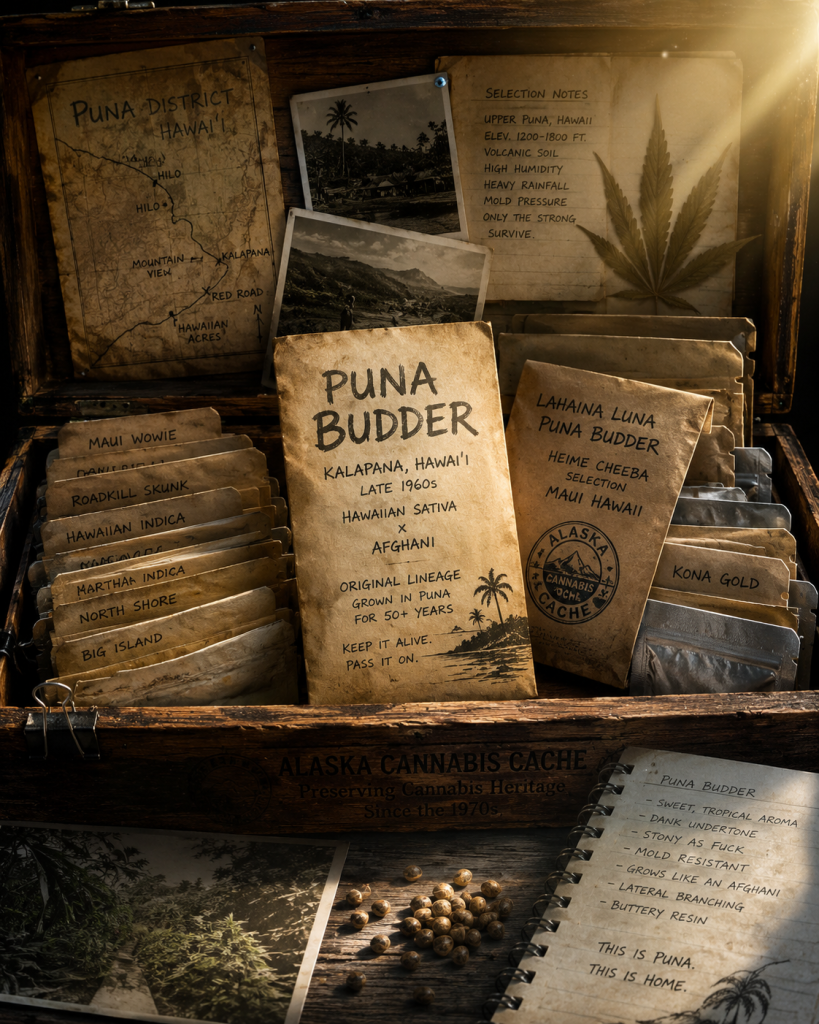
Puna is the district. Lower Puna, Upper Puna, the Red Road, Kalapana, Hawaiian Acres, Mountain View — this is where the strain lived and was grown and named. Budder, Butter, Buddaz — the same word written three different ways by three different people in three different decades, none of whom agreed on spelling because nobody was writing anything down. They were growing.
What the name refers to is the resin. The way it coats your fingers when you trim it. The way it sticks to scissors. The way it moves between your hands. Buttery in the way that exceptional resin is buttery — thick, rich, coating everything it touches. That is where Budder comes from. Not a condiment. Not a jar of Skippy. A texture. A quality. A level of resin production that growers in Puna recognized as something specific and named accordingly decades before the word budder meant anything in concentrate culture.
—
Born in Kalapana
The original Puna Budder was born in Kalapana — the southern edge of the Puna district on the Big Island — most likely in the late nineteen sixties. The cross was Hawaiian sativa meeting Afghani genetics. That combination — tropical sativa structure and effect profile, Afghani backbone for resin production and resilience — is the same fundamental move that produced most of the greatest cannabis strains the world has ever known.
Northern Lights. Skunk #1. Blueberry. AK-47. White Widow. OG Kush. Trainwreck. Cheese. Every single one of those strains traces back to Afghani genetics crossed with something else. Puna Budder exists because someone in Kalapana did the same thing with what was growing on the island. Different place. Same fundamental insight. Same Afghani backbone. Same result — something exceptional that outlasted the generation that made it. It just happened here, on the island, by people who were not writing it down and were not trying to win a Cannabis Cup. They were growing in the jungle and paying attention.
—
What the Real Thing Actually Is
The Professor is not going to describe a grocery store product. Here is what Puna Budder actually is.
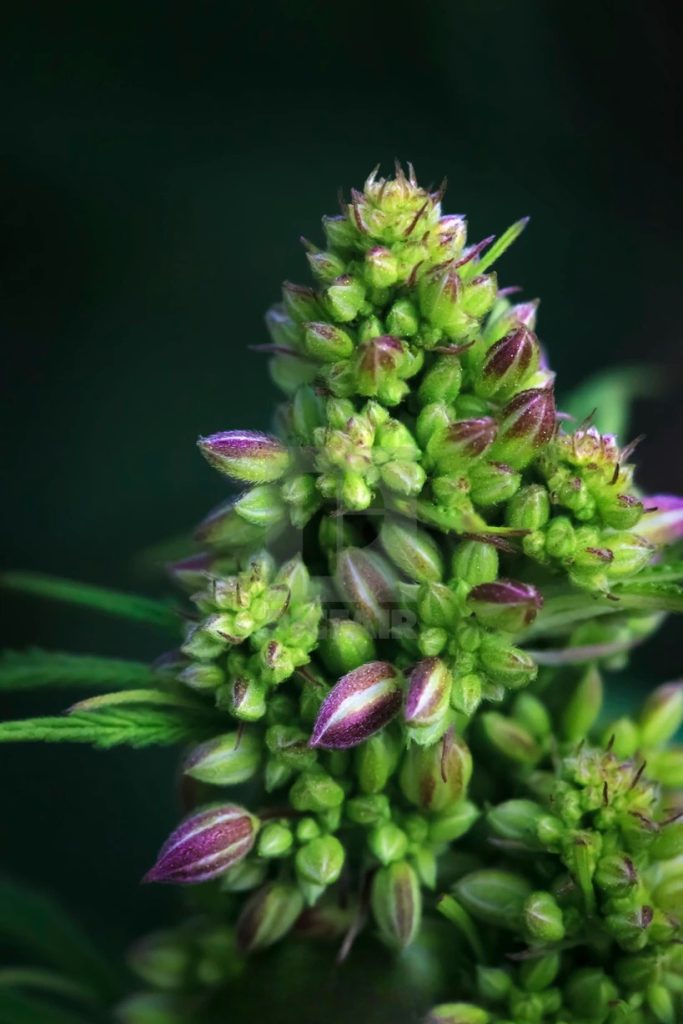
It grows like an Afghani. Not in the way that dense indoor varieties loosely invoke the Afghani influence — in the actual Afghani way. Lateral branches that reach nearly as high as the main cola. The plant builds itself wide and balanced, almost architectural, spreading outward rather than simply reaching up. You look at it in the garden and you see structure. Real structure. The kind of structure that fifty years of selection in a specific place produces when nobody interferes with what the plant is trying to become.
The aroma is sweet and tropical with a dankness underneath that sits in a completely different register. The Professor has been asked to describe it many times and will tell you the same thing every time: it is indescribable. Not because the words do not exist but because the thing itself exceeds what language can do. Anyone who has spent time on the islands knows what Puna tastes like. That is the taste. If you have had it you know exactly what the Professor is talking about. If you have not there is no sentence that will get you there. That is not mysticism. That is just honesty about the limits of language when applied to something genuinely exceptional.
Stony as fuck. That is the effect in the fewest honest words. Not couch-lock indica sedation. Not purely cerebral sativa energy. Something in between that feels like it was designed specifically for this island and this culture — which is exactly what it was. Fifty years of selection in Upper Puna produced something the mainland did not and cannot replicate because the mainland does not have the volcanic soil, the rainfall, the specific latitude, or the half century of uninterrupted growing in these exact conditions that produced this specific expression.
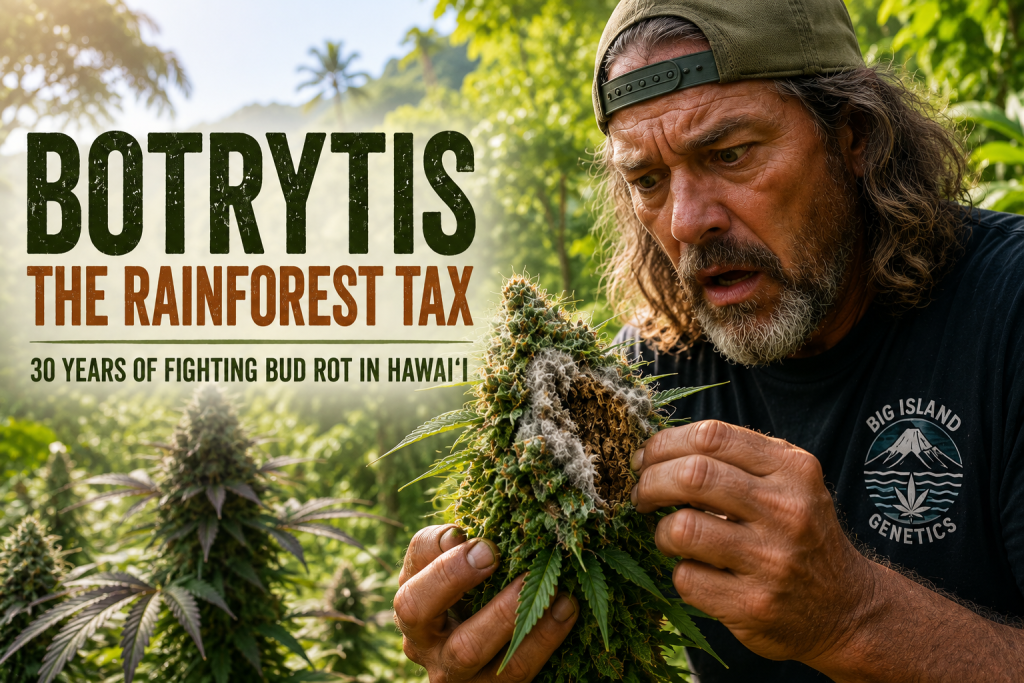
Mold resistant in conditions that destroy everything else. That is not marketing. That is what the plant had to become to survive in the Puna rainforest across fifty years. The ones that could not handle the humidity did not make it to the next generation. The ones that did are the ones the Professor has.
—
The Amsterdam Chapter
In the nineties and early two thousands TH Seeds out of Amsterdam produced a strain they called Puna Budder. Hawaiian sativa crossed with Afghani indica, packaged and sold internationally. It got listed on Seedfinder. It got listed on Leafly. It got written about by people who had never been to Puna.
The Professor obtained those genetics at one point — through Adam Dunn, a genuine connector of real cannabis history whose reach into the world of authentic genetics the Professor respects. The Professor grew the TH Seeds version. Evaluated it. Knows exactly what it is. It is a real strain. It has its own merit. The genetics the Professor got from Adam back then and what Adam has now are not the same as the fifty-year-old lineage that came through Heime Cheeba from Kalapana. Different things. Both real. Not the same.
TH Seeds eventually discontinued their version. The Professor and Adam Dunn are not done with this story. There is a collaboration in the works — the two of them building something forward from what each carries. When that becomes a seed you will hear about it at Big Island Genetics before you hear about it anywhere else.
—
More Than One Puna Budder
There was never just one Puna Budder. The name was a regional identity, not a precise genetic designation. Growers in different parts of the district — different elevations, different microclimates, different decades of selection — were growing their own versions of what they called Puna Budder. What they shared was the place and the selection pressure. What varied was the expression.
The Professor has more than one expression of it. That is intentional. Preserving a living genetic legacy means preserving its diversity, not collapsing fifty years of selection into one phenotype and declaring everything else counterfeit. The plant has always been plural. What it has not been is whatever the internet decided to put on Leafly without asking anyone who actually lived here.
—
The Man Who Kept It Alive: Heime Cheeba
Here is the story that has never been written down anywhere until right now.
Heime Cheeba — born James Schenk — was a grower, breeder, and genetic preservationist who spent forty plus years collecting and protecting cannabis strains from the seventies, eighties, and nineties. He operated out of Ketchikan, Alaska, under the banner of Alaska Cannabis Cache. He was known in the cannabis preservation community as the guardian of Roadkill Skunk — an original cut he received at a gathering in Garberville in the seventies and spent decades backcrossing and preserving. He was a biker and a breeder and a man who believed in open source genetics and passing things on to the right hands. He passed away at sixty-three in Ketchikan. His son and his community are carrying the Cache forward.
But before any of that was known publicly — before the podcasts, before the website, before the cannabis community understood who he was — Heime Cheeba was something else entirely to the people who knew the Hawaiian genetics story. He was a ghost.
He had spent time in Lahaina on Maui in the seventies. He was growing in the hills behind Lahaina Luna High School — classic island strains, Maui Wowie and the rest of the legendary Hawaiian lineup. He got seeds out of Kalapana. He grew them, selected them, and developed what became known as the Lahaina Luna Puna Budder — his own expression of the lineage, shaped by his hands and his land on Maui.
He wanted to pass those genetics on. He found Hawaiians he trusted and gave them the seeds. They lost it. He found others. Same thing happened. Genetics are fragile. People move. Life intervenes. Grows get raided. Seeds disappear.
Heime held on to what he had and waited. Not a year. Not five years. Twenty years. He waited twenty years looking for exactly the right person — someone with the knowledge, the commitment, the roots, and the reverence to carry this lineage forward without losing it again.
He found the Professor on Facebook. Not as himself. Under a false name he became the Professor’s friend and then he watched. For three years he watched — reading the posts, following the grows, observing how the Professor talked about the plant, how he talked about the island, how he talked about the history and the responsibility of carrying something real. Three years of watching before saying a single word.
When Heime Cheeba finally revealed himself and what he had, he was not offering seeds to a customer. He was handing a fifty-year-old lineage to the person he had spent two decades looking for. The Kalapana genetics. The Lahaina Luna Puna Budder. The real thing, intact, uncompromised, still alive after everything Hawaii’s cannabis history had thrown at it — Green Harvest, federal prosecution, prohibition, displacement, the simple entropy of time and lost grows and people who meant well but could not hold it together.
He gave the Professor those seeds. Along with other Hawaiian heirloom genetics that had been quietly disappearing from the island for decades. That is the lineage. That is the truth. That is why Big Island Genetics exists.
—
What That Baton Means
The Professor loved that man. Spoke to him often in the time before he passed. Was selected by him — not chosen randomly, not picked from a catalog, but watched for three years and deliberately entrusted. That relationship and what came out of it changed the Professor’s life forever.
The mission now is the same mission Heime carried for decades: preserve what the original Hawaiian growers built, protect it from being lost again, and make sure it reaches the hands of people who understand what they have and what they owe to the people who kept it alive before them.
This is not a hobby. This is not a business strategy. This is a responsibility that was passed from the original growers of Kalapana, through Heime Cheeba across fifty years of preservation against every odd, to the Professor in Upper Puna. The seeds are alive. The lineage is intact. And now you know the full story of where it actually came from and who made sure it survived.
That is what Puna Budder is. That is why the reputation outlasted the generation that made it. Because the people who carried it took it seriously. And still do.