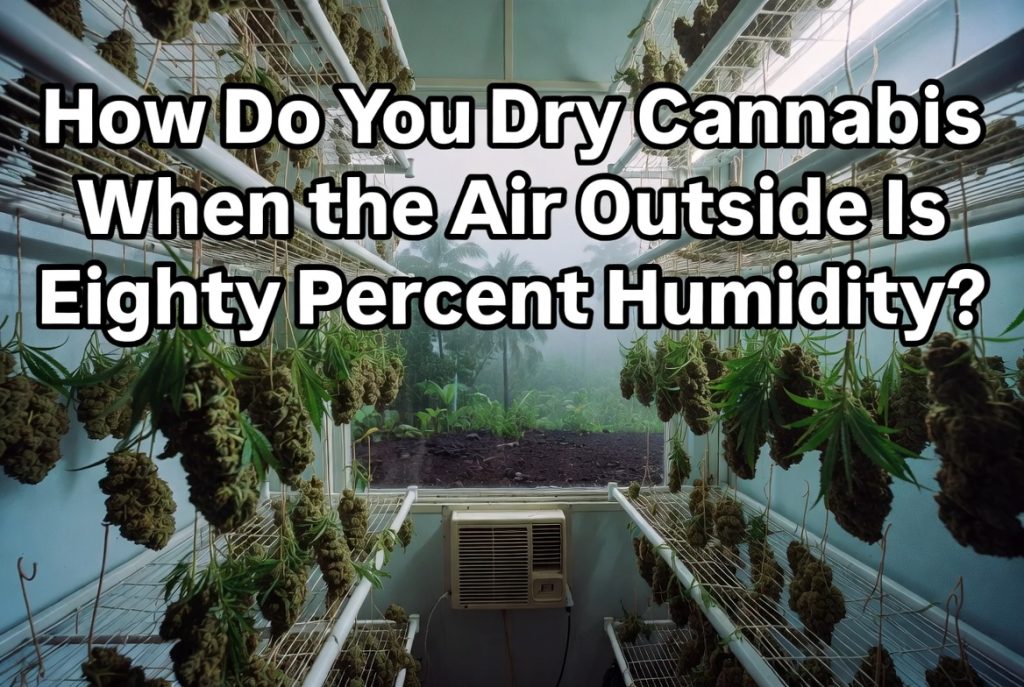
How Do You Dry Cannabis When the Air Outside Is Eighty Percent Humidity?
You build a controlled environment inside and forget the outside air exists, because in Puna it is not going to help you. Ever.
Here is what nobody tells you when you are standing in the garden on harvest day feeling like the smartest person in Puna: that is not the finish line. That is the beginning of a whole new way to lose everything you just grew. You cut it down, you smell it, you smoke a little right there in the garden like a champion — shoots, we all do — and what you do not know is that the mold is already inside your best cola. Not on it. Inside it. Sitting in the dark doing its thing while you are out there taking pictures of your harvest for people who do not grow weed. By the time you see the gray fuzz on the outside, that whole beautiful fat thing you been watching for four months goes straight into the trash. Not trimmed. Not saved. The trash. The Professor has stood over that trash can more than once. Took a moment of silence each time. Did not help. Dry your weed, brah.
—
Forget the Wet Season. In Puna, Every Season Is the Wet Season.
People talk about the wet season out here like it is a thing that arrives in November and politely leaves by April with its hat in its hand. It does not. Any month on the calendar can turn into a ninety-percent-humidity nightmare with no warning and no apology. The air does not check a calendar. It does not care about your harvest timeline. It does not care about anything. It just sits there, heavy and wet, waiting for you to leave a window open.
You want to know what a good dry looks like in Puna? Seven days. That is not rushing it. That is a victory. Five days and you did something right. Four days is a miracle you accept without questioning and never brag about to anyone who grows on the mainland because they will not believe you and the conversation will go sideways. Ten days means something went sideways and you got lucky it was not worse.
Meanwhile in Las Vegas, people are putting humidifiers in their dry rooms because the desert air pulls moisture out too fast. Three-day dry in the Mojave and they think that is a long time. They are over there adding water to the air while we are over here fighting with everything we have got to remove it. Different planet. Same plant. The Professor has no strong feelings about which problem he would rather have. Actually that is not true. Moving on.
Every extra day your flower sits in uncontrolled tropical humidity is another day for what is already happening inside that cola to keep happening. Speed is not the enemy of quality here. Slowness is.
—
The Buds Are Doing the Hula and the Mold Is Doing the Work
Let us be direct about this. Hanging your harvest in a space that shares air with the outside is not drying cannabis in Hawaii. It is composting it on a rack. Nicely arranged composting. Thoughtfully hung composting. Some people put a fan on the buds, watch them swaying in the breeze, and think that looks exactly like drying. It does look like drying. It looks great, actually. The buds are moving, the air is circulating, everything feels under control.
Meanwhile the screen door is open, the windows are open because this is Puna and that is how houses work out here, the humidity outside is eighty-five percent, and the fan is just making sure every single bud gets a thorough and even coating of wet tropical air on a rotating schedule. The buds are doing the hula. The mold is doing the work. The Professor has seen this happen. Has seen weed that was crispy dry — rolling dry, joint-packing dry — left out on a screen with a fan on it for a couple hours and gone soft. The outside air reached in through the screen door and took it back like it was never yours to begin with. Because it wasn’t. Not yet. Not until it is sealed in a controlled room and finished properly.
And here is what is actually happening inside the cola while all that hula is going on. Botrytis starts in the densest part of the bud where airflow is lowest and moisture is highest. You will not see it from the outside. By the time there is fuzz you can spot, the inside is already gone. But sometimes you catch it mid-trim. You are running the scissors down the cola and you see it tucked in there — a little white fuzz on the inside. You trim that off and think you got it. Except you did not get it. Every day your flower sits in uncontrolled humidity that mold is striping further up and further down the inside of the stem. Growers out here call it barber pole — the way the rot spirals through the cola like the stripe on the sign outside the shop. You find a small patch on Tuesday and think you handled it. You check on Thursday and the barber pole has been open for business the whole time. Every day you do not get it dry is another stripe. There is no catching up to it. There is only getting the room sealed and the air controlled before the cut, not after.
Sealed space. This is non-negotiable. A room, a tent, a dedicated structure — it needs to close and it needs to stay closed. Every gap is an invitation. Strip the large fan leaves before you hang. Give every branch its own airspace on the rack — branches touching each other trap humidity between them and that pocket of wet stagnant air is exactly where the next barber pole starts. Move air through the room with a small oscillating fan but do not point it directly at the buds. Move the air in the room. Do not blow it on the plant. That distinction is the difference between drying and watching your harvest do the hula on the way to the trash can.
—
Heat Dries Things. Heat Also Ruins Them.
First instinct when everything is wet: add heat. Heat dries things — that part is true. The second instinct is to put a space heater in a small room, close the door, and check back in a few hours feeling clever. What you find when you open that door is a warm room, warm weed, and the smell and flavor of your harvest no longer in the building. They left. They are gone. You basically made an aromatic sacrifice to the humidity gods and got dry stems in return.
The aroma, the flavor, the way a well-grown plant hits you when you open the bag — all of that starts disappearing above about 70°F. Push past that in a heated dry room and you end up with flower that is technically finished and spiritually empty. Dry, brittle, flat. Smells like hay. Tastes like a decision you regret. The Professor has produced this outcome. Has produced it, stared at it, smoked it, confirmed it was exactly as bad as it looked, and spent the following season doing something different. That is how thirty years works. You stop making the same mistake somewhere around year three or four. Usually.
Dehumidifiers have the same heat problem that nobody who sells dehumidifiers wants to talk about. They pull moisture out of the air by running it over cold refrigerant coils, then exhaust that drier air back into the room warmer than it came in. In a sealed Puna shack a running dehumidifier will push your room temperature up five to ten degrees without blinking. The tanks fill fast too — in a serious harvest room at peak humidity you are emptying that reservoir every few hours around the clock. It is manageable. It is also a 2am chore that will make you question your life choices somewhere around day four. There is a better answer and it has been sitting in the hardware store the whole time.
—
Run the Air Conditioner. Just Run the Air Conditioner.
Cold air holds less moisture. This is not a growing tip or a technique or something the Professor figured out in the bush. This is atmospheric physics. When you drop the temperature in a sealed room, the air’s capacity to hold water vapor drops with it. That moisture condenses out and drains away through a hose you never have to touch. A window unit running in a sealed dry room drops the temperature into the ideal 60–65°F range and removes humidity as a direct consequence of doing that. No reservoir to empty. No heat pumping back into your space. Two problems. One machine. Cheaper to run than a dehumidifier and it does not turn your dry room into a sauna while it works.
If you want to push further — and during that first seventy-two-hour window after cut, when the plant is releasing the most moisture and the botrytis risk is at its peak, pushing further is worth every penny — look up the CoolBot. It is a small controller that overrides the thermostat on a standard window AC unit and allows it to run down into the low fifties or the high forties. Commercial cold storage operators have been using these for years. Cannabis growers are late to the realization, as they are late to several realizations. The CoolBot runs around three hundred dollars. It will pay for itself the first harvest you do not lose.
Fifty degrees Fahrenheit in a sealed room for the first three days after cut. That is a hostile environment for botrytis. That is hostile for mites. That is hostile for most of the things that want to ruin your harvest in its most vulnerable window. Cold air is dry air and dry cold air is your best friend in the first seventy-two hours. Get it cold. Get it dry. Keep it sealed. That is the whole formula.
—
No Power? Use Desiccant.
Not every setup in Upper Puna has reliable electricity. Not every dry situation has a room you can run a window unit in. This is not a failure of preparation — this is the reality of off-grid growing in the Hawaiian rainforest, and there is a legitimate low-tech answer that works and costs almost nothing to maintain once you have it.
Silica gel desiccant beads. Not the little packets from inside a shoebox — those are not what we are talking about. The bulk stuff. Five-gallon buckets of it. The beads start out blue or purple. As they absorb moisture from the air they shift toward pink. When they go pink they are saturated and done working until you recharge them. Pull them out, spread them flat on a baking sheet, put them in the oven at 250°F for a couple of hours, and they go back to blue. Reusable indefinitely. The Professor has desiccant beads that have been doing this job for years. They still work fine.
Here is the mechanism, because understanding it makes the whole method click: the desiccant is not pulling moisture out of the plant. The plant is releasing moisture into the air around it. The desiccant is pulling that moisture out of the air. The dryer the air, the faster the plant releases. You are managing the atmosphere, not the bud directly. Keep that straight and the geometry of the setup makes perfect sense.
The setup is horizontal layers. Mesh screen with buds laid out flat — not piled, flat, with space between them. Next screen below it, desiccant beads spread out across the full surface. Another screen, another layer of buds. Another layer of desiccant. Stack as many layers as the space allows. The reason you spread the beads flat across a screen instead of dumping them in a bucket is surface area. Beads at the bottom of a deep bucket are barely touching air. Beads spread flat across a screen are working at full capacity across every inch. The more desiccant surface you expose to the air, the faster the air dries, the faster the plant releases, the faster you get to the snap. Every layer is doing real work. Nothing is just sitting there looking busy.
Swap the pink beads for fresh blue ones every couple of days and you are actively managing the moisture load around the clock with zero electricity. Akamai. That is the move.
One hard warning: do not use cedar blocks, moth balls, scented drawer liners, or any scented moisture-absorbing product anywhere near drying cannabis. Those products are designed to release fragrance into the air. Your drying buds will absorb that fragrance directly into the flower. They will smell like a cedar closet or your grandmother’s dresser drawer. The Professor has smelled cedar-cured cannabis. It did not win any awards. It did not deserve any. Unscented silica gel only. Every time. No exceptions.
—
How Do You Know When It’s Done: The Stem Snap
One reliable indicator. No equipment required. No guessing. Take a smaller stem — a lateral branch, not the main stalk — and bend it. If it bends without breaking, there is still moisture in the wood and in the bud wrapped around it. Put it back. Keep drying. If it snaps clean — not slowly, not with resistance, a sharp clean snap like dry kindling — the initial dry is complete and the flower is ready to move.
Seven days in a properly controlled room at the right temperature and humidity and most harvests in Puna are at the snap. Dense long-season sativas grown full term in Hawaiian Acres can take a few days longer. The stem tells you. Trust it more than the calendar, more than how the buds feel on the outside, more than your impatience, which will be considerable by day five. The Professor knows. The impatience is always considerable by day five.
Do not skip this test. The Professor has jarred flower that felt dry on the outside and watched it go soft and grassy three days later because the moisture redistributed from the dense inner bud back out through the flower. Felt dry. Was not dry. Cost a jar and a week. The stem snap does not lie, brah. Do the test every time.
—
Trim It, Freeze It, Finish It Later: The Professor’s Move
Here is something the Professor does that most people are not doing, and if you are storing cannabis for any length of time in this climate it is worth understanding completely.
When the harvest is almost there — buds are smokeable, definitely dry enough, stems are getting close to the snap but not quite there — the flower is still a little sticky. The resin is active. Try to roll a joint and the weed sticks to your fingers, clumps up, does not pack clean. That stickiness is residual moisture still present in the trichomes. In that state the flower is not ready to sell, not ready to store long term, not ready for a jar.
What you do is trim it. Right then. Make it look exactly the way you want it to look — clean, finished, presentation ready. Then put it into one-gallon ziplock bags and put those bags in the freezer.
That is the whole move. The flower stops right there, at almost-dry, sticky, smelling exactly like it should, everything intact, nothing lost to time or oxidation or another day of sitting in Puna air. Frozen and waiting.
When you are ready to use it — next week, six months from now, a year from now — pull it out of the freezer and give it that last finishing dry. A few hours in a cool controlled room. A day laid out on a screen. That final twenty-four hours of drying happens right before the flower gets used, not months ago at harvest. The flower does not know it has been in the freezer. It finishes the way it would have finished the day after harvest.
What you end up with is freshly dried cannabis that happens to be a year old. Sticky. Green. Smells and tastes exactly like the day you trimmed it. Most people are either rushing the dry and losing quality or sitting on jars and losing freshness. This is the third option. The Professor got here the same way he gets to most things — take a technology that already works somewhere else, understand what it is actually doing, and put it to work where nobody thought to put it. Thirty years of thinking sideways and raiding other people’s toolboxes.
And there is a second way to use the freezer that is even more aggressive — and honestly more useful when conditions are truly hammajang and you have no controlled space ready at all.
Wet trim. Right off the plant. Cut the buds off the stems while everything is still fresh and wet, trim them up, put them straight into large ziplock freezer bags, seal them tight, and freeze them. No dry room needed. No humidity fight. No race against the clock. The weed goes from the garden into the freezer and stops right there, preserved exactly as it was the moment you cut it.
When you have a proper environment to dry — a sealed room, controlled conditions, a setup that is actually right — you pull the bags out and finish the job at your leisure. The drying happens when you are ready for it, not when the harvest is forcing your hand. That is the difference between preservation and panic.
The other thing worth knowing: fresh frozen wet-trimmed flower straight off the plant is exactly what concentrate makers are looking for. If you have someone in your world who does extractions, that bag out of your freezer is premium material to them. So even if you end up not drying that particular batch at all, it did not go to waste. The freezer turned a potential disaster into options. Avoid the ruin first. Figure out the destination second.
—
One More Rabbit Hole Worth Knowing About
There is a whole other level of this conversation that is not going to fit in this post but you should know it exists. People are drying cannabis in freeze dryers now. That is a real thing that real growers are doing and the results are not what you would expect from something that sounds like beef jerky technology applied to weed. And there is a machine called Cryo Cure — patented technology built specifically for cannabis — that takes fresh-cut flower from harvest to shelf-ready in twelve to sixteen hours. Flash freeze it, run it through a controlled vacuum cycle, and the moisture sublimates directly from ice to vapor without ever passing through liquid. Trichomes intact. The smell and flavor locked in like the plant never left the garden. Not a generic freeze dryer repurposed from the food industry. Something engineered for this plant specifically, and it shows in what comes out the other end.
Both of those are their own deep conversations. You can find them, along with thirty years of everything else the Professor has been building in volcanic soil at the edge of the rainforest, at Big Island Genetics.