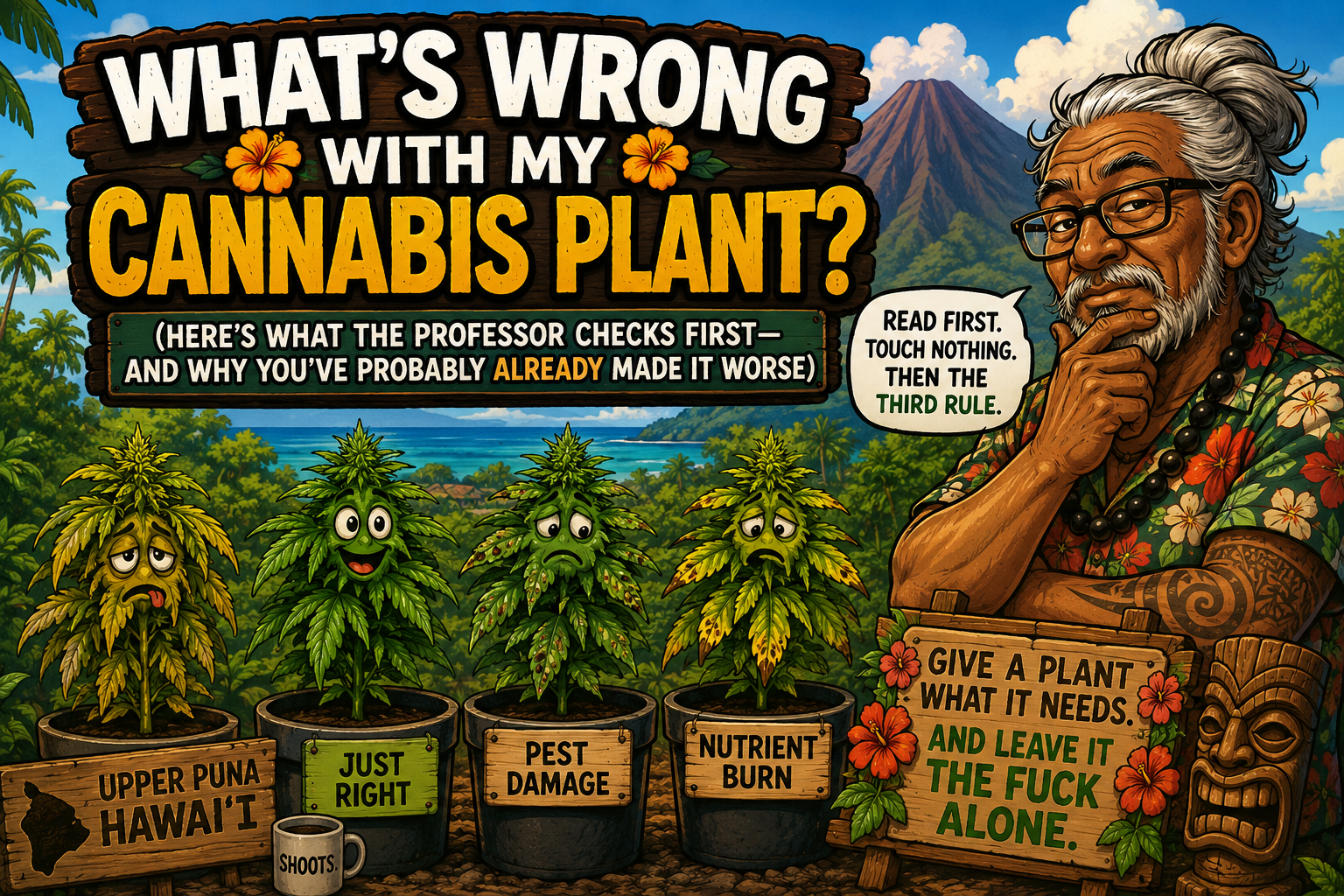
What’s Wrong With My Cannabis Plant?
Here’s What the Professor Checks First — And Why You’ve Probably Already Made It Worse
Somebody calls. Says their plants don’t look right. Could be a friend, could be a friend of a friend, could be somebody who heard the Professor knows things. Doesn’t matter. He shows up, walks through the gate, and starts reading the garden before he says a word.
No checklist. No spray bottle. Just thirty years of watching plants in Upper Puna volcanic soil tell the truth about everything that has ever happened to them.
Here is exactly what he looks for, and in what order.
—
Nobody Calls the Professor Because Everything Is Fine
Let’s get that out of the way first.
By the time somebody picks up the phone, they have usually already done something. Sprayed something. Added something. Adjusted something. Maybe they diagnosed it themselves, maybe they asked the internet, maybe they just panicked and grabbed da kine — whatever da kine happened to be — off the shelf and went to work. All of that is fine. The Professor has done every single one of those things himself. Some of them more than once. Some of them in the same week.
Thirty years is a long time to be wrong in interesting ways.
The first thing he does when he walks in is nothing. He stands at the edge of the garden and looks at the whole picture before he moves toward any one plant. Something will stand out. It always does. Then he gets to work.
—
The Soil Surface — Two Seconds, Then Move On
Before he touches anything, he scans the soil surface. Not a deep investigation. Two seconds, maybe three. He is looking for obvious activity — fungus gnats hovering just above the medium, ants running lines between containers, anything moving around on top of the soil that should not be there.
You would be surprised how often the answer is sitting right there on the surface in plain sight and the grower walked past it six times that week without seeing it. Sometimes the whole situation is hammajang and the fix was two seconds away the entire time.
He is not checking moisture yet. Not digging around. Just a fast visual sweep. If something obvious is there, he clocks it. Then he moves up to the plant.
—
Posture First — But Don’t Stop There
The first thing the plant tells you is in its posture. Droopy leaves mean something is wrong. What exactly? That is the question, and the list of answers is longer than most people think.
Underwatering droops a plant. Overwatering droops a plant just as fast — and overwatering is far more common, especially among growers who love their plants a little too enthusiastically. Excessive heat droops a plant. Certain pathogens droop a plant. Root problems droop a plant.
The drooping is not the diagnosis. It is the plant waving its hand. *Hey. Over here. Something is not right.* The diagnosis comes from everything else.
The number one growing tool in most beginner gardens is a watering can with no off switch. The number two tool is another watering can. The Professor’s Third Rule exists for a reason and we will get to it at the end — but brah, if you are standing there looking at droopy leaves and your first move is to water them, read that rule first.
—
Color, Surface, and What the Leaf Is Actually Saying
After posture, color. Healthy cannabis is a specific, vibrant green that a thirty-year grower recognizes the way a musician recognizes a note being slightly flat. When it goes wrong, the variation points somewhere specific.
Yellow spots suggest fungal activity. Brown tips and canoeing leaflets — edges curling upward like a canoe hull — usually mean **nutrient burn** or excess. Pale, unusual yellowing with weird venation patterns points toward **deficiency or lockout**. Crinkly, malformed leaves with distorted serration mean something has been working on that plant at a cellular level for longer than you realize.
Every problem a cannabis plant has falls into one of three categories: **pathogen, nutrient, or environment.** That is the whole list. The entire job in the first sixty seconds is figuring out which category you are in — because the response is completely different for each one, and the wrong fix makes everything worse.
Occam’s razor applies here. The most obvious answer is usually right. Usually. The Professor has been fooled enough times to know when it isn’t, and he knows how to tell the difference. Even after thirty years he will stand in front of a plant for a minute sometimes, head slightly tilted, working through it. The plant is not always speaking plainly. That is okay. Start with the most likely answer and work outward from there. That is akamai. That is the move.
—
Stippling — Slow Down Here
When the color read points toward pest activity, the Professor looks for stippling. Tiny pale dots scattered across the leaf surface like someone went at it with a pin. It looks minor. It is the opposite of minor. Stippling means something with a mouth has been feeding on that plant — **spider mites**, **russet mites**, aphids. Those dots are puncture wounds. By the time you can see them clearly, the population has been working for at least a week.
When he sees stippling, he does not go straight to the sick leaves.
He goes to the healthy ones first.
He flips a leaf on a plant that looks completely fine — no stippling, no visible damage, nothing wrong. And he looks. Gets his eye close. Gives it real time. This is not a two-second move. Small things do not announce themselves and the absence of obvious movement does not mean the absence of bugs. You have to really look. The Professor has flipped plenty of leaves that were infected as hell — **aphids**, mites, the whole situation — and nothing was visibly moving. You are looking for presence first. Bodies. Movement confirms life but absence of movement does not confirm absence.
When he finds something, he drags a finger lightly across the surface.
If it smears, it is alive. If the bodies fall away dry — choke dead bugs, brah, just falling off the leaf clean — they are pau. Done. Dead.
That one gesture is the smear test. It tells him whether he has an active infestation or the aftermath of one. The difference between those two things determines everything that happens next.
—
The Story That Explains All of It
A grower called the Professor in because their plants were getting worse after they sprayed. They had noticed minor stippling on a few leaves — not alarming, just there. They sprayed, did a decent job of it. Next day, little more stippling. Day after that, more. That is when they called.
He walked in and did not go straight to the sick plants.
He went to the ones that looked fine.
He flipped a healthy leaf. Choke tiny bodies on the underside. He did the smear test. Dry. Fell away clean. Then he walked over to a symptomatic plant and flipped a leaf there too. Same thing. Dead.
He did not say anything yet. Just nodded.
*”Eh braddah — did you spray recently?”*
Yes.
That was all he needed to hear. But he still did not say anything. He walked the grower over to one of the healthy-looking plants — no stippling, no visible damage, looked completely fine. He flipped a leaf and showed them what was on the underside.
Choke dead bugs on a leaf that looked perfectly healthy.
The grower’s eyes went wide. They started moving through the garden themselves, flipping healthy leaves, finding the same thing everywhere — plants that looked completely fine, covered in dead bodies on the underside. Now they were convinced the infestation was massive, the spray had done nothing, the whole room was compromised. Ready to nuke the whole operation.
That is when the Professor told them what they were actually looking at.
The bugs on the sick leaves were dead. The bugs on the healthy leaves were dead. All of them — pau. The spray had worked completely, including on plants that never showed a single symptom. What they were seeing on those healthy leaves was not an active infestation. It was a receipt. Proof the spray got everywhere it needed to go.
The stippling that was still appearing — and would keep appearing over the next few days on leaves that looked perfectly fine right now — was not new damage. It was old damage still surfacing on a delay. Those healthy leaves had bugs on them before the spray hit. The bugs died there. The damage those bugs already did was still working its way to the surface. The infestation was pau. The evidence of it was still arriving.
*”Expect more stippling over the next few days,”* he told them. *”Do not freak out. It is coming regardless of what you do right now because it was already set in motion before you ever sprayed. Hold your nerve, stay on your spray schedule going forward, and watch the new growth. That is where you will see the plant coming back.”*
Without that last instruction, they spray again. Panic escalates. They reach for something stronger and create a brand new problem on top of a solved one. With it, they hold their nerve because they know exactly what is coming and what it means.
That is what thirty years looks like. The beginner goes straight to the sick leaves. The Professor flips the healthy ones first. Everything he needed to know was right there — on the leaves nobody else thought to check.
—
The Week Nobody Accounts For
This is the most important thing in this entire post. Read it twice.
Whatever you are looking at right now happened at least a week ago.
A pest infestation does not show symptoms the day it starts. A nutrient deficiency does not show symptoms the day the roots stop taking something up. A fungal infection does not show symptoms the day the spores land. The plant processes damage internally for days before anything surfaces visibly. By the time you are standing there looking at stippling, yellowing, or spots — the cause is already a week old, minimum.
Same lag in the other direction. You spray correctly, you kill the mites, you fix the problem — and then over the next week the symptoms get worse anyway. Because the damage showing up now was already done before you ever sprayed. The new growth coming in will be clean. The leaves that were already damaged will keep showing it.
Growers see this and assume the spray did not work. They spray again. Now they have a new problem on top of a solved one.
Same thing with nutrition. You add a missing element — give it a week before the plant responds. You flush excess — give it a week. You stunt a plant from **underwatering** — give it a week before it bounces back. The delay between cause and visible effect runs in both directions, always, without exception. Understanding this one thing changes how you respond to everything you see in a garden.
The plant is not being dramatic. It is showing you last week’s news. You are reading yesterday’s paper and wondering why the stock prices are wrong.
—
Read First. Touch Nothing. Then — The Third Rule.
The instinct when a plant looks wrong is to fix it immediately. Grab something, spray something, reach for da kine. That instinct is the enemy of good diagnosis.
Read the plant completely before you touch anything. Check the soil surface. Check posture — all the possible causes, not just the obvious one. Check color. Check for stippling. Go to the healthy leaves first. Flip them. Get close. Give it real time. Do the smear test. Figure out which of the three categories you are in before you reach for any response. Then account for the week — always account for the week.
Here is the truth that thirty years in **Upper Puna volcanic soil** keeps proving out: most of the damage in any garden was caused by the grower. Too much water. Too much spray. Too much intervention before the diagnosis was complete. The Professor has done all of it. Probably will again. If you are bummed about making the same mistake twice, you are not going to last very long growing weed, brah.
Which brings us to the Third Rule. The one that sits above every technique, every triage system, every smear test and spray schedule in this entire encyclopedia:
**Give a plant what it needs. And leave it the fuck alone.**
The plant knows what it is doing. Your job is to read it correctly, respond to what it actually needs — not what you think it needs, not what you read it needs, not what you panicked and grabbed — and then get out of the way and let it grow.
Thirty years in this soil, and that is still the whole lesson. The plant is already telling you what happened. Your job is to be quiet enough to hear it.
— Professor Potgrower