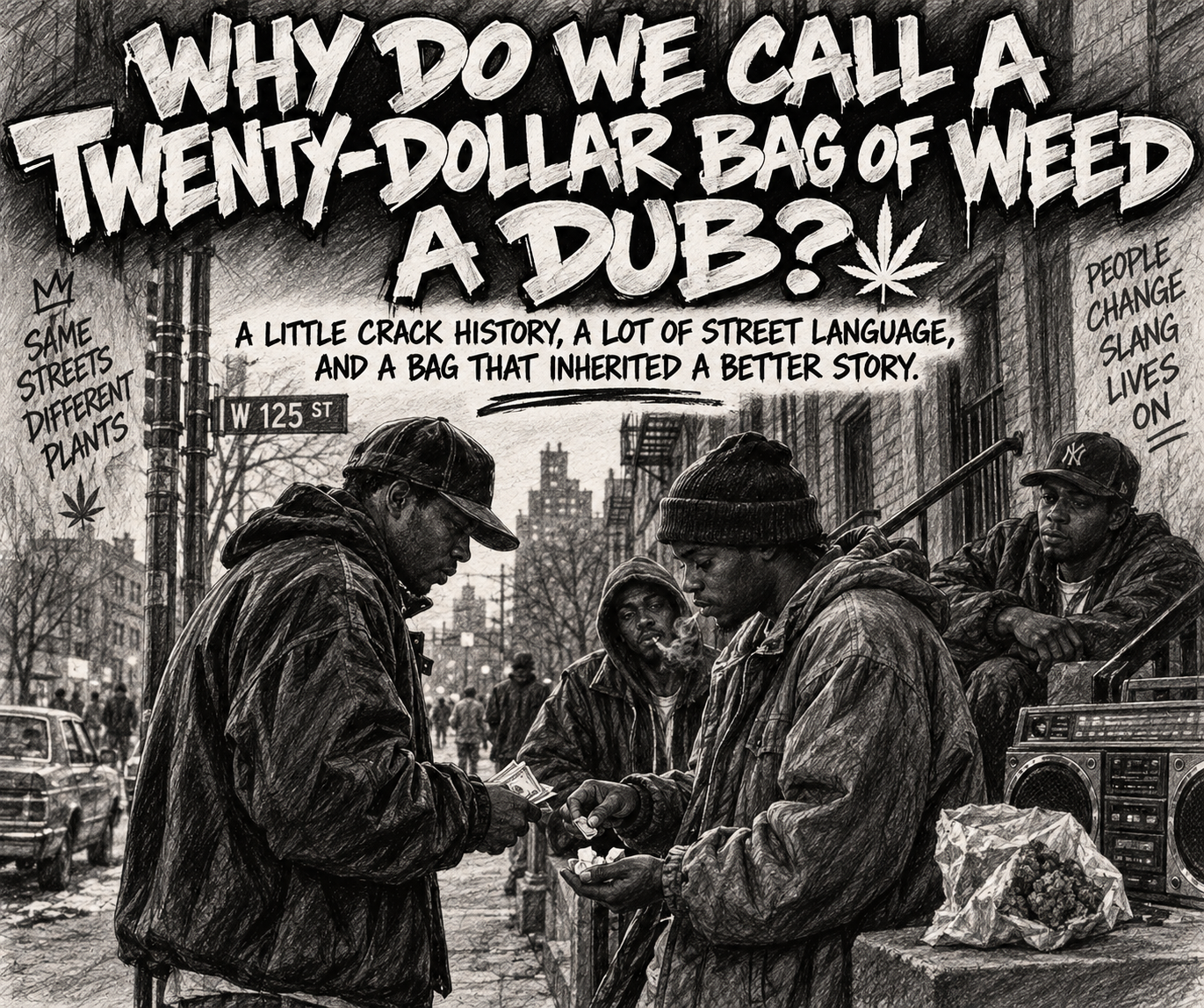
A dub means twenty bucks because crack got there first. Cannabis inherited the word secondhand, decades after crack dealers were running a two-for-one on rocks and calling it a double-up. The promotion died. The word didn’t. And somewhere along the way weed culture picked up the leftover slang and never looked back.
I know that because I was standing there for the part nobody wrote down, brah.
Nobody Was Calling It a Dub
I bought weed. I sold weed. I knew people whose entire personality was “currently trying to locate weed.” Not one of them ever said “lemme get a dub.” That phrase did not exist in my world yet. Twenty dollars was just twenty dollars, and if you wanted a bag you said so like a normal person instead of using code words like you were running a spy network out of a Volkswagen.
Then crack showed up and ruined the neighborhood’s vocabulary in ways nobody saw coming.
Crack dealers, being enterprising businessmen in the way that only unregulated felons can be, occasionally ran a two-for-one. Two rocks for the price of one. This was called a double-up, and — I promise you I did not make this up for the bit — it’s sitting right there in the historical record as actual street terminology. A real promotion, from a real industry, with zero customer service department and somehow still better return policies than most streaming services.
People shorten everything. KFC. ID. Fridge, a word that murdered the letter D and got away with it in broad daylight. So double-up became dub. Nice, clean, efficient. The kind of linguistic economy that would make a soil chemist proud, if soil chemists cared about slang, which as far as I know they do not.
Then the Promotion Ended and Nobody Sent a Memo
Here’s the part that’s actually funny if you sit with it for a second. Economics did what economics does. The two-for-one disappeared. There was no ribbon-cutting ceremony announcing the end of the double-up era. No corporate memo went out reading EFFECTIVE MONDAY, ALL DOUBLE-UPS DISCONTINUED. You just stopped getting the second rock.
Nobody renamed anything. The word stuck around long after the deal it described had quietly died in its sleep. That’s the whole joke, and the Professor isn’t going to explain it any further than that. Reader does the math.
Because the transaction itself was twenty dollars, the word slowly drifted from meaning “the deal” to meaning “the price.” A dub stopped being two rocks and started being twenty bucks — full stop, no rocks required.
Wait — Doesn’t “Dub” Already Mean Twenty Dollars?
Yes, and this is where I have to be honest instead of letting a good story run wild, because the Authority Test doesn’t care how funny the bit is. Old American money slang already tied “dub” to twenty dollars, probably through double sawbuck — a sawbuck being ten, a double sawbuck being twenty. So no, some corner-standing crack dealer did not invent the English word dub out of thin air. That etymology predates him by a mile.
What I’m telling you is more specific than that, and it’s the part that never makes it into the word-origin threads: drug culture gave the word a second life. The cannabis world I came up in wasn’t calling twenty-dollar bags dubs before the crack-era double-up got shortened and started circulating. I watched that happen. Crack had its dub first. Weed got it later, secondhand, the way little brothers inherit everything — the bike, the nickname, the reputation they didn’t earn.
Talk Story, No Receipts Required
Nobody was taking minutes on this. There is no Secretary of Street Slang somewhere with a ledger that reads Tuesday, 8:47 p.m. — double-up officially shortened to dub, motion seconded, passed unanimously. Language doesn’t work like that. It moves dealer to customer, customer to friend, friend to a song, song to a different city, different city to a different drug entirely — and twenty years later some kid puts it on Urban Dictionary and everybody assumes that’s the origin story.
Most of the time nobody’s around who actually lived through the transition. This time somebody is.
The two-for-one disappeared. The dub didn’t. And now you know why the twenty you hand somebody for a bag is quietly haunted by a crack promotion that ended before most of today’s buyers were born.
Shoots.