How Do You Pollinate Cannabis Plants?
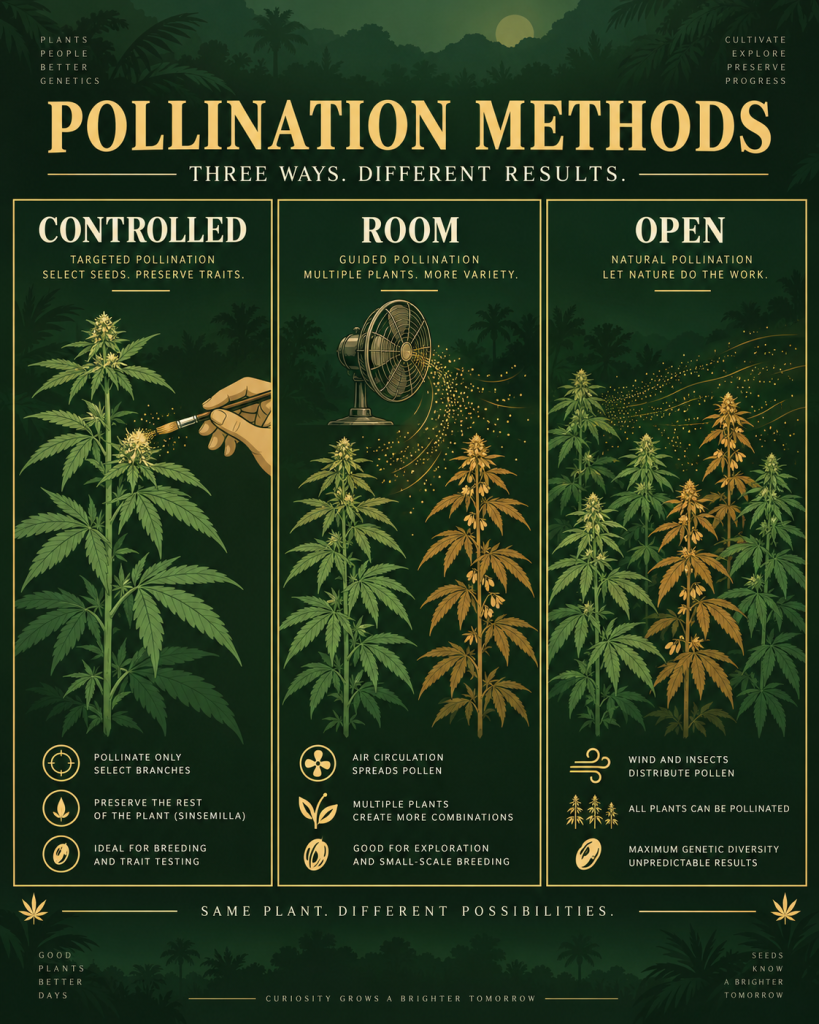
There are three ways to pollinate cannabis, and each one is a different tool for a different job. Controlled hand-pollination uses a brush to apply pollen to specific branches — maximum precision, fully traceable lineage, one known male donor per tagged cross. Room pollination places a male and female together in a closed space with a fan running — intentional coverage, less labor, broader distribution across the whole plant. Open pollination runs multiple males across multiple females to maximize genetic diversity on purpose. Knowing which method to use, and when, is most of what separates a real breeding program from a jar full of mystery seeds.
—
## The Method You Choose Depends on What You Are Trying to Build
The instinct for most new breeders is to treat controlled pollination as the only serious method and everything else as sloppy work. That is a mistake.
Each method is a tool. Each tool has a job. The question is not which one is correct in the abstract — it is which one matches what you are trying to accomplish right now.
If you are making a specific cross with a known male donor and you need every seed traceable to that exact pairing, you use controlled pollination. If you want to cover a female thoroughly without spending an afternoon with a paintbrush, a healthy male in the same room with a fan circulating is efficient, effective, and produces good seed. If you are hunting for exceptional phenotypes across a broad genetic population — or working within an inbred line where a controlled amount of diversity is exactly what you want — open pollination is not an accident waiting to happen. It is a deliberate strategy.
All three methods produce real seeds with real genetics. The one that is wrong for your program is the one you chose without knowing why.
—
## Controlled Pollination: When You Need to Know Exactly What You Made
Controlled pollination is the most labor-intensive method and the most precise. It is what you use when lineage documentation matters more than speed or volume.
**Isolate the male the moment preflowers show.** Male calyxes form as tight clusters at the node regions near the end of vegetative growth. When the pollen sacs start hanging downward on their stems, you have maybe 24 to 48 hours before they open. Move him to a separate closet with cool white fluorescent lighting immediately. Not this weekend. Now.
**Collect pollen with a sterile black film canister and tweezers.** Hold the canister beneath a mature flower and tap the top gently. Pollen falls into the container without crushing plant material into the mix. The black interior gives you visual contrast so you can see the yellow dust clearly while you work. Avoid bagging flowers — condensation kills pollen fast. Avoid paper catches — one draft and your whole collection is gone.
Pollen has three enemies: moisture, heat, and light. Store it sealed in a deep freezer. It holds viable for up to six months this way. After eighteen months, germination rates start dropping sharply.
**Pollinate at least four weeks before your intended harvest date.** Cannabis needs that full window to build a complete seed casing. Slower sativa-dominant strains may need six weeks. Pollinate too late and you will harvest seeds that look finished but are hollow inside.
When you are ready to apply: turn off every fan in the space first. Load a small sterile paintbrush or cotton swab with pollen. Paint the white pistils directly on the branch you have chosen — contact with the receptors, not a coating of the whole bud. Tag the branch immediately with the donor strain’s name. Pollinated pistils will shift color within a day or two as confirmation the transfer worked.
When brushwork is done, mist everything that was not just pollinated with plain water. Pollen dies on contact with moisture. This kills any stray airborne dust before it reaches plants you intended to keep seedless.
One female can carry crosses from three different males on three separate tagged branches simultaneously. That is the real power of this method — not just precision, but flexibility within a single plant.
—
## Room Pollination: Let the Fan Do the Work
Room pollination is exactly what it sounds like. You place a sexually mature male and one or more females in the same sealed environment, run a fan to move the air, and let the plant do what it evolved to do.
This is not open pollination. It is intentional and reasonably documented — you know which male was in the room and which females were present. What you get is thorough, even coverage across the entire female plant rather than targeted branches. The seed set will be heavier and more uniform than a brush run.
Use this method when you want good seed volume from a known cross without the labor of branch-by-branch application. It works well when you have a male donor you trust and a female you want to fully seed for a production run. It is also practical when plant structure makes brush access difficult — dense canopies, large outdoor plants, anything where targeted brushing would eat most of a day.
The tradeoff is granularity. Every branch gets the same pollen from the same male. You cannot run multiple crosses on the same female in the same run. For production seed runs, that is fine. For multi-cross breeding experiments, use the brush.
—
## Open Pollination: The Case for Controlled Chaos
Open pollination has a bad reputation it does not entirely deserve.
The critique is fair when applied carelessly — unknown pollen drifting through a shared grow space, mystery males hitting plants nobody intended to breed, seeds with no traceable lineage ending up in a production canopy. That version of open pollination is a real problem.
But deliberate open pollination — running multiple males across multiple females of a known population, with documentation of who was present — is one of the most effective tools in a breeder’s kit for one specific purpose: **phenotype hunting**.
When you cross a single male to a single female, you get one genetic combination. When you run multiple males across multiple females, you generate a wide range of combinations in a single generation. More combinations means more phenotypes to evaluate. More phenotypes means a better chance that something exceptional surfaces in the population. If you are trying to find one extraordinary plant out of five hundred, open pollination gives you a richer selection pool than any single controlled cross can provide.
**The inbred line exception is worth understanding specifically.** IBLs have already been stabilized through generations of selection. The genetic range within the line is narrow by design. Running open pollination across an IBL — different males from the same line pollinating multiple females from the same line — introduces a controlled amount of diversity without bringing in foreign genetics. You are still inside the line. The foundational traits stay intact. But because different males carry slightly different expressions of those traits, the offspring will not all be identical copies of each other.
This is why experienced growers can smoke what is supposed to be the same strain twice and swear the two batches were completely different. They probably were. Same original line, different males involved in different runs, different combinations of the same genetics expressing themselves in slightly different ways. That is not a labeling error or a quality control failure. That is open pollination within a line doing exactly what it is supposed to do — keeping the genetics alive and interesting across generations without losing the core of what the line is.
Most of what the cannabis world calls inconsistency is actually undocumented diversity. There is a difference, and it is worth knowing.
—
## Reading What You Actually Made
Four to six weeks after pollination, seed pods on your pollinated branches or plants will swell and start cracking open. That is your harvest window regardless of which method you used.
Pull seeds out by hand. Gently. Squeezing sticky calyx pods crushes seeds, and crushed seeds do not germinate.
Nonviable seeds are easy to spot — pale cream, white, or light green, soft to the touch. They did not finish. Toss them. A viable seed is hard, dark gray or brown, with clear striping or banding across the shell. That pattern means the casing is complete and the genetics inside are intact.
What you do next matters as much as the method you used to make the seeds.
Write down what you ran. Which males. Which females. Which method. Which date. If you ran open pollination, note how many males were present and what their phenotypes were. If you ran controlled crosses, note every tag on every branch. The seeds are the result. The records are the work.
Without documentation, every method eventually collapses back into the same outcome — interesting plants you cannot fully explain and cannot reliably reproduce.
Nature has been running open pollination on cannabis for ten thousand years and produced some of the most remarkable genetics this plant has ever expressed. It also kept no records whatsoever, which is why most of those genetics are gone.
You have the records. Keep them.