How To Fix Hawaiʻi’s Cannabis Future… and Why It Starts With Us
Short answer: Because too many people believe the outcome is already decided.
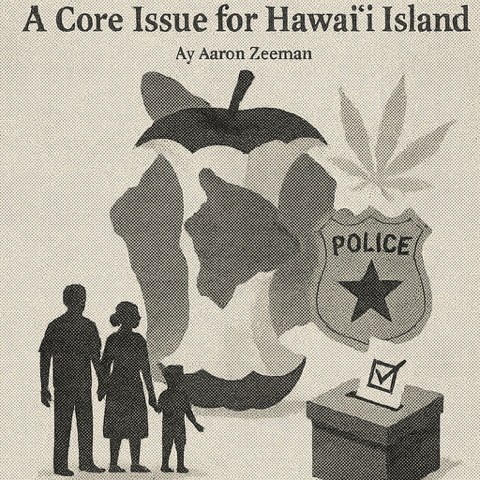
Hawaiʻi likes to think of itself as politically aware, culturally grounded, and deeply democratic… but if we’re honest, a lot of people here don’t believe their vote actually changes anything. We rank near the bottom in voter participation. Incumbents rarely lose. In a one-party dominant state, the real contest usually happens in primaries decided by a small fraction of the population. By the time the general election rolls around, it can feel like the decision has already been made.
People don’t disengage because they’re lazy. They disengage because the system feels predetermined. And that perception—right or wrong—shapes behavior.
Cannabis is sitting right in the middle of that same structural problem.
What Does Cannabis Have To Do With Voter Participation?
Short answer: The same structural inertia that discourages voting is shaping cannabis policy.
For decades, cannabis in Hawaiʻi survived because of people, not because of policy. It lived in backyards, in lava cracks, in red dirt under full sun. It was carried forward by growers who understood this land and respected it. Culture carried it. Community preserved it.
Then legalization arrived… and instead of restoring that legacy, we built a regulatory fortress. Licenses were limited. Vertical integration became a gatekeeping device. Participation required capital most local cultivators simply didn’t have. What was supposed to be liberation started looking like filtration.
The same feeling that keeps voters at home—the sense that outcomes are pre-shaped—is the same feeling many legacy growers had watching the new system unfold.
If we want to fix one… we probably have to look at the other.
Why Make Cannabis a Constitutional Right in Hawaiʻi?
Short answer: Because anchoring it in the Constitution shifts it from permission to mandate.
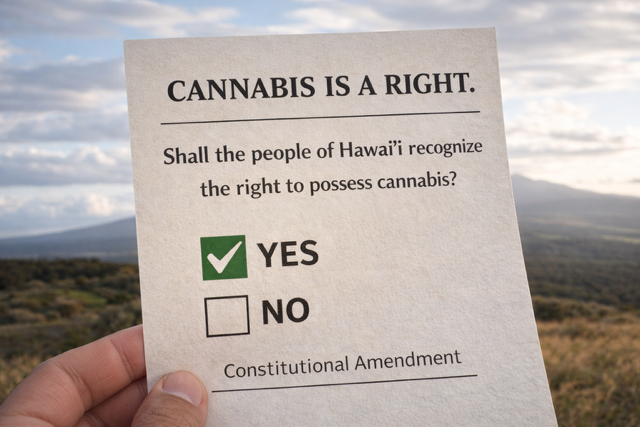
Right now, cannabis cultivation exists at the discretion of regulators. It is allowed within boundaries designed by agencies and adjusted by legislative politics. A constitutional amendment would fundamentally change that starting point. It would anchor cultivation in the will of the people.
When something becomes constitutional, it can’t be quietly reshaped in a back room. It requires public alignment. It requires accountability. It forces transparency because the baseline assumption changes (and baselines matter more than people think).
A ballot amendment also does something else… it forces statewide engagement. It makes the question unavoidable. You can ignore a committee hearing. You can’t ignore a constitutional vote.
And participation grows when relevance grows.
Can Cannabis Unite Hawaiʻi Voters?
Short answer: It’s one of the few issues that actually can.
Veterans use it. Families use it. Farmers understand it. Elders remember when it wasn’t treated like contraband. Young people never accepted that it should have been criminalized in the first place. Cannabis is one of the rare issues that cuts across generational and political lines.
This isn’t just a plant issue. It’s a participation issue.
If a constitutional amendment guaranteeing responsible cultivation were placed on the ballot, it wouldn’t just be about cannabis. It would be about ownership. It would give people something tangible to vote on—something rooted in daily life rather than abstract political positioning.
Relevance drives turnout. Always has.
How Did Prohibition Distort Hawaiʻi Cannabis?
Short answer: It reshaped cultivation through enforcement instead of agriculture.
When helicopters determine breeding timelines, something is off. When plant structure evolves around visibility risk instead of environmental optimization, something is distorted. Prohibition didn’t eliminate cannabis here. It pressured it. It altered it. It pushed genetics toward survival logic instead of agricultural logic.
Yet despite that pressure, the plant adapted. The culture adapted. Growers preserved fragments of lines that could have vanished.
What’s missing now isn’t resilience. It’s structural acknowledgment.
What Would a Better Cannabis System Look Like?
Short answer: One that mirrors agriculture instead of enforcement.
Farmers farm. Processors process. Retailers retail. That logic already exists across every other crop in Hawaiʻi. Tomatoes don’t require ten million dollars in vertical integration before someone can grow them. Coffee doesn’t require a full-stack corporate structure before entry. Cannabis is a plant. It requires soil, light, water, labor, and stewardship. The agricultural framework already exists.
A constitutional amendment wouldn’t solve every detail overnight… but it would set the foundation. It would establish cultivation as a right rather than a privilege filtered through capital barriers. From there, regulation could align with biology instead of fear.
How Does This Fix Hawaiʻi’s Democratic Problem?
Short answer: People show up when they believe something belongs to them.
If Hawaiʻi is ever going to reverse its voter disengagement problem, it won’t happen through lectures about civic duty. It will happen when people believe their vote shapes something real.
Cannabis has that potential. It connects culture, agriculture, economy, identity. It touches real lives. It carries history.
And if you’ve ever seen someone remember their first real Hawaiian smoke—the pause, the slight smile, the quiet “you know what I mean?”—you understand this isn’t nostalgia. It’s recognition.
The world will want what Hawaiʻi can produce. That part is inevitable. The real question is whether we design a system that keeps that future here… or whether we let it be shaped elsewhere while we watch from the sidelines.
Because once people realize something belongs to them, they show up.