The Professor Potgrower’s Hawaiian Grow Guide: The Full Jungle Blueprint
Voice: Professor Potgrower | Strategic Project: Big Island Genetics Heritage Preservation
A Note on This Guide: Global Versatility
While this guide is written through the lens of the Hawaiian jungle and our decades of island experience, these techniques are not restricted to the Pacific. The lessons we have learned fighting the most intense humidity, pests, and volcanic conditions on Earth are universal. Whether you are growing in the humid Southeast, the arid High Desert, or a controlled environment in Europe, these protocols for foliar defense, soil chemistry, and genetic selection will work for just about any other grow and any other place. If you can master the jungle, you can grow anywhere.
The Cardinal Rules of the Jungle
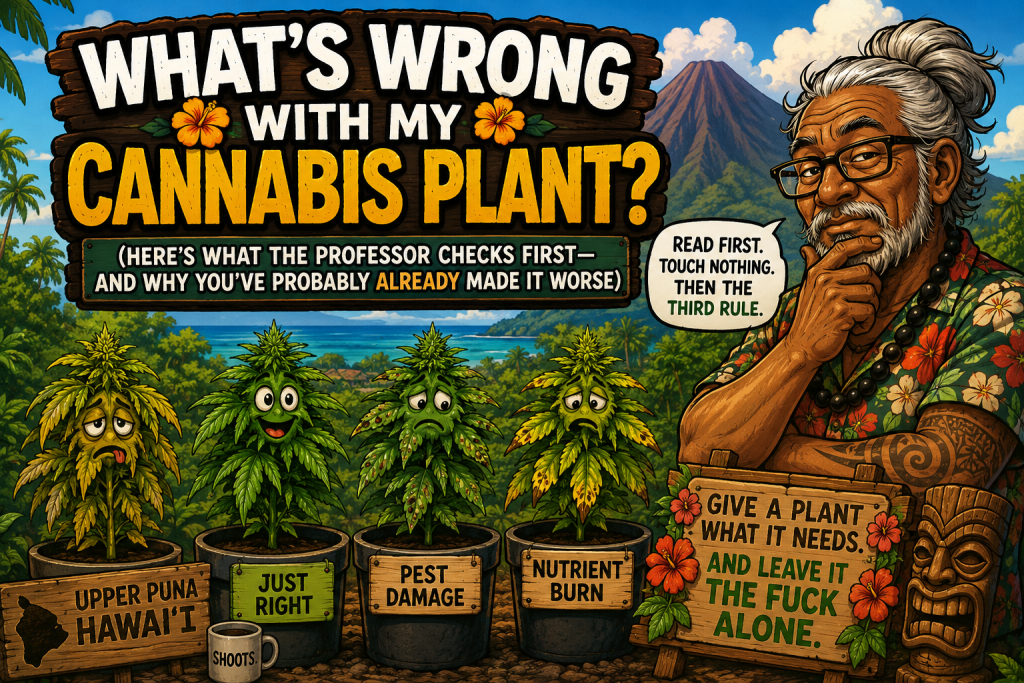
Rule #1: “Give the plant what it needs and leave it the f*** alone.”
Most people f*** plants up. If a plant has a problem, it’s usually because a human touched it. They water too much, or they don’t water enough. They over-fertilize or they under-fertilize. They spray when they shouldn’t, or they f*** with the pH when they should have left it be. Giving the plant what it needs, at the exact time it needs it—that is the art. But it’s easier. When you give it the right things, at the right time, the plants will do better, and it won’t be as hard. You’ll be less work, but you have to do it when the time is called. Once those needs are met, your only job is to stay out of the way and let the biology do the work.
Rule #2: “Strain selection is the most important thing to consider in growing cannabis.”
Choosing your—it’s not choosing. There’s picking, there’s choosing, and there’s selecting. Pick is “pick a card.” Choose is “choose a mate.” Select is very determined. Selecting is the highest right choice. You can’t out-grow a seed’s code. I don’t care how much fertilizer you give them, if that’s not genetic giant plant genes in it, then that’s not going to happen. A seed can only do what those genetics say it can do. Selection is the most important thing to consider in growing cannabis.
Rule #3: “You will never realize a plant’s potential if you don’t know what it is.”
Make sure you know what your potential is. Even though you’re growing super great weed, it might be the best you’ve ever grown, but does that mean you did as good as that plant could have done? Well, how do you know? That’s really important. Learn about cannabis, learn about strains, what they can do and how they react, and that way you can realize your plant’s potential—or at least try.
Section 1: The Sovereignty of the Hawaiian Sun & Cannabinoid Synthesis
We like to use the Hawaiian Sun for a couple of reasons, but one is it’s free. Not only is it unmatched for quality—and not only have all grow rooms attempted to try to replicate the Hawaiian Sun and have for 50 plus years—but it’s free. Why pay some of the highest electric and where I live, the highest electric bills in the Northern Hemisphere, when we don’t have to? We have the Hawaiian Sun, and it is free. It is a nuclear reactor in the sky providing the perfect spectrum.
The UV-Cannabinoid Connection
UV (ultraviolet) light is not just a light source; it is a chemical trigger. There is a strict, direct correspondence between the amount of UV light a plant receives and the amount of THC it produces. UV light is absolutely critical for the synthesis of THC, THCV, and other rare cannabinoids. The plant produces these compounds as a natural sunscreen to protect its reproductive organs (the seeds) from solar radiation. Because we are closer to the equator and sitting in the middle of the Pacific, our UV levels are off the charts. This intensity triggers the plant to produce more resin and thicker cell walls as a natural sunscreen. That radiation is the primary engine behind the legendary potency of the islands.
Section 2: The Sprout Gauntlet – The First 72 Hours
Starting seeds outdoors is the goal because the sun is way better, but those initial cotyledons (the seed leaves) are sugar-storage devices full of carbohydrates. To a hungry animal, they are food.
The Rodent Raid (Rats & Mice): They will chew the tops right off your little sprouts. They can go through a complete overnight and wipe out 600 f***ing seedlings. Defense: Hardwire mesh or elevated benches are non-negotiable.
The Cardinal Signature: You’ll know it’s a Cardinal because they’ll rip the little sprout right out of the hole and eat the tip off it. All you’ll see is that one little taproot laying there. Defense: Bird netting or small cages.
Slug Stealth: Slugs smell fresh sprouts from a mile away and they are way faster than you think. Defense: Slug bait is good, and keep a small cage or netting over your seedlings until they have their first true leaves. Once they have the first two leaves, rats, mice, and birds will leave your s*** alone.
Section 3: Deep Soil Logistics & The “Lime-First” Mixing Protocol
In spots like the Hāmākua Coast, upper Mountain View, and Volcano, we are blessed with 12 feet of real soil. You can amend it with Cinders, peat moss, Pro-Mix, and Sunshine Mix.
The Acidification Reality
Tropical rain is not acidic—this isn’t “acid rain” like you find on the East Coast from factories. What actually happens is it rains so much that the positively charged ions from the water accumulate in the soil. Over time, all that water ends up making the soil more acidic because of that positive ion transfer. This is why you MUST put lime in there.
The Lime-First Rule
Because of that ion transfer, you must add Dolomite Lime (1-2 tbsp/gallon). However, the order of operations is everything:
Step 1: Mix the lime into your soil base first.
Step 2: Add your organic “fruit” (amendments like worm castings, guano, and compost) and mix them in after the lime is integrated.
The Danger: If you mix the lime and organic amendments together at the same time, they will react and combine to create salts. These salts cancel out your lime and your fruit. Over time, the salts can be a problem if you keep using the same soil. Mix it right to keep the nutrients bioavailable.
Section 4: Foliar Defense & Night Ops Protocol
Use Monterey Horticultural Oil (mostly mineral oil). It suffocates thrips, mites, and aphids and kills their eggs.
The Surfactant Secret: Use a high-end surfactant or wetting agent. It makes a huge difference. You can use anything from cheap soap to expensive agents, but I suggest spending the money on the good stuff. Every so often, switch it up—throw some Pyrethrins in there every second or third spray.
The Shiny Leaf Advantage: Using this oil gives you nice shiny leaves on the surface, and I’ve never seen powdery mildew growing on a shiny leaf.
H2O2 Tactic: You can spray Hydrogen Peroxide (3%) directly on the buds and leaves. It f***s up the pH for pathogens like powdery mildew and Botrytis, making it impossible for them to survive. It’s safe for the plant and highly effective.
Targeting the “Black Death” Mite
“Black Death” looks like gnarled, twisted, purple, or black malformed growth at the leaf tips. This is caused by microscopic mites (like Broad or Russet mites) living deep inside the growing tips (apical meristems).
The Ambush (Night Ops): You must spray one hour after dark. You aren’t doing this for sun-scorch; you’re doing it because these mites are active and crawl out of the protection of the tips only at night. If you spray during the day, they are hiding too deep and you won’t get them.
Method: Get into the very tips of the branches and the nodes. Soak the small parts where they hide.
Lunar-Based Caterpillar Warfare
Spray Bacillus Thuringiensis (BT) 3 days before the full moon. That is when the moths (especially the small triangle ones) come out and fly around to drop eggs. If you harvest on the back half of a full moon (falling into a new moon), you’ll have a lot less incidents of moths. This is how we do it in Hawaii, but it works for any other place where these pests are a factor.
Section 5: Regional Microclimates & The Big Island Blueprint
Match your genetics to your microclimate.
Lower Puna: The Tropical Pressure Cooker. Hot, humid, and sitting on raw volcanic energy. (Global Match: Thailand, Vietnam).
Upper Puna & Mountain View: The Rainforest Lab. 200+ inches of rain. (Global Match: PNW Fall).
Volcano & The Highlands: The Alpine Chill (4,000 ft). Cold nights (40s) and high UV. (Global Match: Himalayas).
South Point & Ocean View: The High-Desert Windstorm. Arid and rugged. (Match: Arizona, Morocco).
The Hāmākua Coast: The Lush Corridor. Deep soil and vertical drainage. (Match: Humboldt/Mendocino).
Kona & Kohala (Hawi): The Gold Coast. Afternoon shade protects resin from boiling off. (Match: Mediterranean).
Section 6: Humidity—The Performance Enhancer
Mainland growers treat humidity like a disease. Out here, it’s our rocket fuel. High humidity keeps the stomata wide open, allowing the plant to process CO2 at maximum velocity. We don’t fight it; we balance it with temperature (VPD) and constant trade wind airflow.
Section 7: Breeding for Resilience & “Aloha Armor”
We use natural selection. If a plant can’t handle a week of solid rain, it’s out. We breed for Aloha Armor: airy bud structures that breathe and loud terpene profiles (pinene/limonene) that act as natural antifungals. Look for internode spacing that allows air to move through the flower.
Section 8: Jungle Pests with Gym Memberships
The Ant/Aphid Syndicate and Caterpillar Paratroopers. Use sticky barriers like Tanglefoot for ants and biological controls like BT for caterpillars. Keep those stalks clean.
Section 9: Beating the Grey Mold (Harvest)
The Morning Shake-Down: Physically shake the water out of your buds after every rain.
The Final Strip: In the last 10 days, pull the larger fan leaves to increase airflow.
The Early Call: If you see rot, cut the branch immediately. An early harvest beats a 100% loss.
Section 10: Drying & Curing: Cold Tech
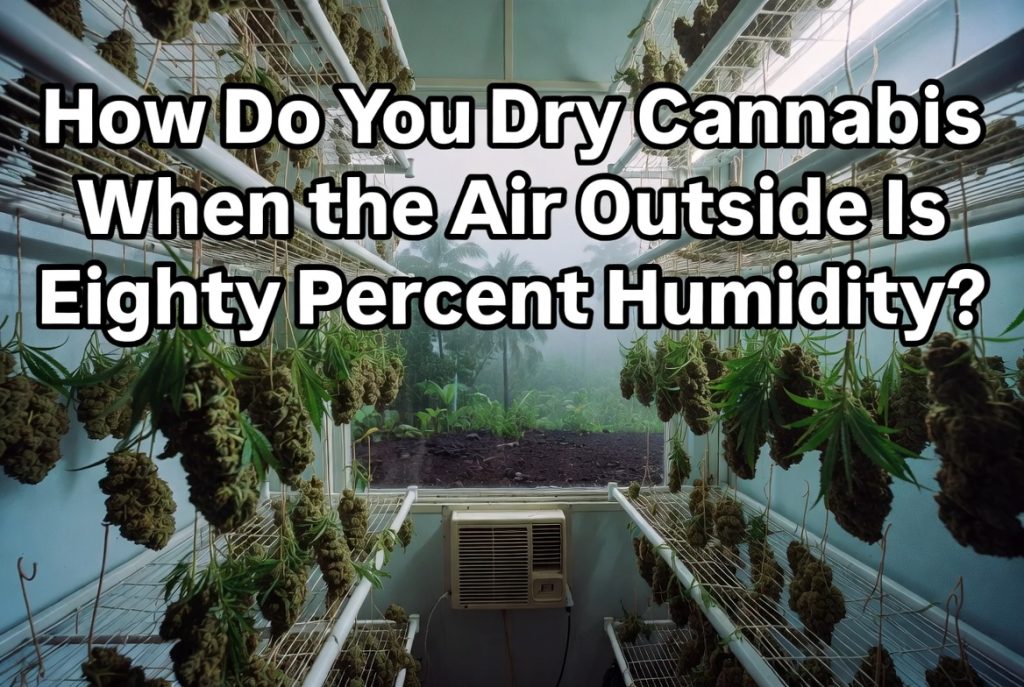
If possible, freeze dry or use a refrigerated room.
The Chilled Room: Aim for 55 degrees and 55% humidity. This halts the mold dead. In warm/humid air, mold continues to grow even after harvest. The cold keeps the buds nice and green and stops the rot from breaking open.
Standard Method: Use circular airflow and dehumidifiers until you pass the “Snap Test.”
Section 11: Respect the History, Protect the Genetics
These seeds are living history. When you grow a strain like Kona Gold, you are a steward of a 50-year legacy. Treat it with respect. Protect the genetics. Aloha.