
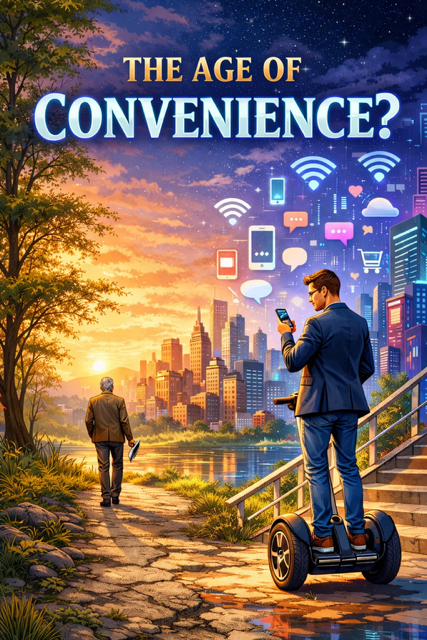
# The Age of Convenience: Are We Living in It Right Now?
Yes, I think we are. I think the **Age of Convenience** is not just a catchy phrase, but a real phase of modern life — a period where more and more systems are being built around removing friction, reducing effort, and making everything faster, smoother, and easier. The upside is obvious. The harder question is what all that convenience may be quietly costing us.
## What I Mean by the Age of Convenience
When I say **Age of Convenience**, I’m not talking about one app, one invention, or one lazy habit. I’m talking about a pattern. A direction. A civilizational drift happening across almost every domain at once.
Food gets easier. Travel gets easier. Communication gets easier. Shopping gets easier. Entertainment gets easier. Research gets easier. Thinking, in some cases, starts getting easier too. You can see the same logic everywhere: remove friction, reduce delay, simplify effort, streamline the process, smooth out the rough edges, automate the hard part, outsource the skill.
And of course a lot of that sounds great, because a lot of it is great. Nobody wants to go back to dying from infected teeth, washing clothes by hand until their shoulders give out, or navigating a strange city with nothing but luck and bad handwriting on a gas-station map. A lot of convenience is a genuine civilizational win. That part matters, and any honest discussion has to start there.
But that is only half the story.
The other half is that when you remove friction, you are not always just removing inconvenience. Sometimes you are also removing the thing that was building a capability. That’s the part that interests me.
## Convenience Is Not Just Helping Us. It Is Shaping Us.
That’s the real point. Convenience is not passive. It is not neutral. It does not just sit there waiting to be used. It changes the environment, and when the environment changes, people change with it.
If you do not need to memorize phone numbers, you stop memorizing phone numbers. If you do not need to navigate, you stop building the internal map. If you do not need to wait, you stop practicing patience. If you do not need to cook, you stop developing food literacy. If you do not need to sit with boredom, you stop discovering what boredom used to build.
The outcome remains, but the underlying capability starts thinning out. That’s the trade. And because the system still produces the result, the trade is very easy not to notice.
You still get where you’re going, so who cares if you no longer know the route? You still eat, so who cares if you can’t cook? You still get an answer, so who cares if you didn’t really think through the question? You still communicate, so who cares if you’re getting worse at sustained face-to-face conversation?
That is how something big can happen without anyone officially announcing it. The outputs still appear. Daily life still functions. The cost hides underneath.
## Why This Is Bigger Than “Technology Bad”
This is where people get confused. The minute you criticize convenience, they think you’re doing the old-man-on-the-porch routine, like you want to smash everybody’s phone, churn butter, and go back to frontier life. That’s not what I’m saying at all.
Technology is not the enemy. Modern medicine is not the enemy. Refrigeration is not the enemy. Clean water is not the enemy. The washing machine is not the enemy. GPS is not the enemy. Even AI is not automatically the enemy.
The issue is not whether these things are useful. The issue is whether we ever stop to ask what the friction was doing before we removed it.
Sometimes the friction was useless and miserable, and good riddance. A lot of human history was brutal, exhausting, and needlessly painful. No sane person wants to restore all that. But some friction was doing something. Some friction was developmental. Some friction was formative. Some friction was not just a burden; it was part of the process that built the person.
And modern systems are not really designed to make that distinction. They are designed to remove friction. Period. If something feels slower, harder, more uncomfortable, or more effortful, the default assumption is that it should be optimized away.
That assumption is often right. But not always.
## What Friction Used to Build
This is where the whole thing gets interesting.
Waiting built patience. Walking built stamina. Getting lost built navigation. Cooking built skill. Repairing built practical intelligence. Boredom built imagination. Being forced to remember things built memory. Having to deal with real people in real time built social fluency. Having to think something through before an instant answer arrived built internal cognitive structure.
That’s not nostalgia. That’s environment.
People did not become more patient because they read books about patience. They became more patient because the world made them wait. People did not become more physically capable because they all had discipline. They became more physically capable because daily life required movement. People did not become more socially comfortable because they took seminars. They became more socially capable because life forced them into repeated unscripted interaction with other people.
The environment built the person.
That’s the sentence I keep coming back to. The environment built the person. And when the environment changes, the person it tends to build changes too. That’s why I think this is not just a culture complaint. It’s a systems issue.
## The Age of Convenience Is Also the Age of Assistance
What we call convenience is often really assistance. Constant assistance. Navigation assistance. Memory assistance. Shopping assistance. Entertainment assistance. Social assistance. Increasingly now, even thinking assistance.
And again, that is not automatically bad. But we should at least be grown-up enough to admit that if a system is constantly assisting you, then it may also be constantly replacing something you would otherwise have had to do yourself.
At first, that feels like pure improvement. Later, it can become dependency. That’s when the logic gets more serious.
Because once a system becomes the normal path, the alternative stops being trained. The old skill starts becoming unusual. Then specialized. Then rare. Then invisible. Then people act like it never mattered in the first place.
That’s how a population baseline moves. Not with a bang. With convenience.
## Why *Idiocracy* Still Feels Funny
This is why the movie *Idiocracy* sticks in people’s minds.
Not because everybody thinks we’re literally turning into a cartoon, and not because the future arrives all at once with an official announcement that civilization is now stupid. It sticks because the movie exaggerated something real enough to be recognizable.
The systems still work. The products still show up. The food still arrives. The screens still glow. The machine still delivers the outcome. But underneath all of that, the absurd starts to feel normal.
That’s the phrase that matters to me: **the absurd starts to feel normal**.
The joke in *Idiocracy* is not just that people are dumb. The joke is that degraded standards, bizarre behavior, spectacle, shortened attention, and a culture trained by convenience and entertainment can all get amplified until nobody inside the system is shocked anymore. Everything becomes self-reinforcing. The ridiculous becomes ordinary. The sideways becomes background. The embarrassing becomes culture.
That’s why it’s funny. Because underneath the exaggeration is a real mechanism.
And I’m not talking here about random moral panic or every stupid thing people do online. I’m talking about pattern recognition. If you have lived in more than one world, you can see when a baseline has moved. You can see when something that would once have registered as obviously unserious, degraded, or absurd now just gets absorbed into the flow of normal life.
That is not just about culture. That is about adaptation.
## The Most Dangerous Part Is Not Decline. It’s Normalization.
This, to me, is the heart of the whole issue.
The danger is not only that certain capabilities may decline. The danger is that the decline becomes normalized so smoothly that people stop experiencing it as loss.
That’s what makes this hard to talk about. If something disappears quickly, people notice. If it disappears gradually, and the system keeps delivering the outcome, most people don’t. They adapt. The baseline slides. The expectation lowers. The new normal installs itself.
You don’t notice that fewer people can cook if takeout is everywhere. You don’t notice weaker navigation if everyone has GPS. You don’t notice attention thinning out if all media keeps adapting downward to match it. You don’t notice less patience if every platform in your life is built around removing every wait.
The system adjusts to the weakened user, and then the weakened user experiences the adjusted system as normal.
That’s the loop. And once that loop is established, it gets harder to see the thing clearly from inside it.
## This Isn’t About Blame
I also want to be clear about this: I do not think individuals are failing in some grand moral sense by responding to the world they were given.
If your environment is optimized for convenience, then using convenience is rational. If every system around you is designed to reduce friction, then choosing the lower-friction path is what people are going to do. That is not some shocking revelation about weakness. That is normal human behavior under the conditions provided.
The issue is not that people are bad. The issue is that environments are powerful.
And if you build an environment that stops requiring certain things, then fewer people will develop those things. That’s not an insult. That’s just how human beings work.
Which means this whole topic is less about blame than it is about awareness. You can’t make good trade-offs if you can’t see the trade.
## So What Is the Actual Question?
The real question is not “Is convenience good or bad?”
That question is too stupid to be useful.
The real question is: **what specific friction was removed, and what was it doing before it disappeared?**
That is the question people almost never ask.
What was the waiting doing? What was the effort doing? What was the boredom doing? What was the difficulty doing? What was the old process building that the new one no longer requires?
If the answer is “nothing worth preserving,” fine. That’s easy. Remove it and move on.
But if the answer is “it was building patience,” or “it was building skill,” or “it was building memory,” or “it was building judgment,” then the trade is more complicated than it looks.
And that, to me, is what the Age of Convenience is really about.
Not rejecting modern life. Not fantasizing about the past. Not acting like all friction is sacred. Just trying to see the pattern clearly enough that we stop sleepwalking through it.
## I Think We’re Still Too Early to See the Full Bill
That may be the weirdest part of all this. I don’t think we’ve even seen the whole cost structure yet.
We are still in the middle of the process. AI is now reducing friction in writing, research, design, coding, summarization, and thought organization. That is happening right now, in real time, before we have fully understood what smartphones, social media, streaming culture, and always-on digital life already did to attention, memory, boredom, social interaction, and internal problem-solving.
So the cycle is speeding up.
The convenience wave arrives first. The cost accounting trails behind. That alone should make people at least a little cautious. Not hysterical. Not anti-progress. Just conscious.
## I Want to Hear What Other People See
That’s why I’m putting this out there.
Do you think we’re living in the **Age of Convenience**?
Where do you see it most clearly in your own life? What has convenience genuinely improved for you? And what, if anything, do you think we may have quietly traded away to get it?
I’m especially interested in specific examples. Weird examples. Everyday examples. Stuff you’ve noticed in yourself, your kids, your work, your habits, your memory, your patience, your relationships, your attention, whatever.
The more honest and specific, the better.
—