# Have You Ever Heard of Glow-in-the-Dark Cannabis?
## Well, you’re gonna hear about it here.
Fuck no, I’m not talking about something you can just walk in and buy off a dispensary shelf right now.
I’m talking about something a little weirder than that. China starts showing off real glowing plants, glowing ornamentals already exist in the real world, and the second people realize that plants can actually do this shit, every stoner brain on earth starts leaning in the same direction. You don’t need to be a genius to see it. The minute glow leaves the toy aisle and shows up in living plants, weed enters the conversation. Not because there’s already some polished product sitting there. Not because the science is done. Just because that’s where the imagination goes.
And honestly, I get it completely, because I’ve been into glow-in-the-dark shit since I was a kid.
Not in some casual, “oh cool, that’s neat” way either. I mean I loved that stuff. Glow tape. Glow posters. Glow stars on the ceiling. Anything that charged up under light and then kept humming in the dark like it had some secret life of its own, I wanted it. If it glowed, I was in. If it glowed green, even better. If it looked like it came from the future, or from a toy store on another planet, I was already sold.
That kind of thing gets into your head early. It never really leaves.
So when I saw the news about China showing off glowing plants, my brain did not go into nice, tidy science-writer mode. My brain went exactly where millions of other weed brains are going right now:
**Oh shit. The glow future is here.**
And once the glow future shows up, cannabis culture is not going to act normal about it. Not for one second.
Let’s not bullshit each other. If the world starts making plants glow in the dark, cannabis culture is not going to respond with restraint, moderation, and scholarly emotional balance. Weed culture has been flirting with glow, blacklight, neon, hidden-ink weirdness, cosmic posters, surreal plant imagery, and late-night altered-state aesthetics for decades. Hemp branding has been leaning into plant mystique and natural-future symbolism forever. Cannabis people already love anything that makes a room, a ritual, a poster, a tray, or a plant feel a little stranger, a little sexier, a little more futuristic, a little more forbidden.
So no, it is not surprising that glowing plants instantly make people think about cannabis, weed, and hemp.
That was always gonna happen.
—
## Why does glow-in-the-dark stuff hit people so hard?
Because glow does two things at once. It feels scientific and magical at the same time, and people are absolute suckers for that combination.
A thing that lights itself up without flame, without a visible bulb, without some obvious dumb explanation, just feels wrong in the best possible way. It feels futuristic. It feels a little illegal. It feels like you found something from a civilization with better toys than ours.
That reaction is old.
Kids love it. Weirdos love it. Artists love it. Stoners definitely love it. Scientists love it too, except they get to use more expensive words while they’re freaking out. Pretty much anybody with a halfway functioning imagination sees something glowing in the dark and has the same first reaction:
**Okay, that’s cool as hell.**
That’s why glow tape worked, why glow stars worked, why glow posters worked, why hidden-ink shirts still work now. The minute something has a daytime version and then some secret second life after dark, it gets more interesting. Glow is not just a look. It’s a reveal. And human beings have always loved reveals.
—
## Grandpa’s radioactive watch was the original “this seemed like a good idea at the time”
Back in the day, glow-in-the-dark was not always cute.
Sometimes it was straight-up radioactive.
That old watch glowing on Grandpa’s dresser looked cool as hell when you were a kid. Then later you find out a lot of those old watch dials used radium paint, and all of a sudden your innocent little glow nostalgia gets punched in the mouth by industrial history. As a kid, you think, “Cool, it glows.” As an adult, you think, “Wait, was Grandpa sleeping next to a tiny nuclear accessory?”
That’s part of what gives glow its weird staying power. It starts as wonder, and every now and then you find out the old-school version was dangerous as hell. Humanity has been chasing glow for a long time. We’ve just gotten better at not poisoning ourselves while doing it.
And honestly, that’s one hell of a bridge into the present.
Because now we’ve gone from radioactive watch dials and toy-store glow junk to actual glowing plants.
That is a crazy sentence, but here we are.
—
## Did old-school glow have real science behind it, or was it all novelty-store bullshit?
Oh, the science was real all right.
Some of the early glow stuff was genuinely gnarly. Radium paint got used on watch dials and instruments because it glowed on its own, and that eventually turned into one of the uglier stories in industrial history. Later, safer phosphorescent materials took over for the fun stuff people actually remember — glow toys, glow stickers, glow novelty junk, glow stars, glow safety markings, glow road paint, glow everything.
So glow was never just some gimmick.
It always lived right there on the border between chemistry, wonder, novelty, and culture.
Which is exactly why weed culture was destined to fall in love with it.
—
## Did China really show off glowing plants, or is this more internet bullshit?
This part appears to be real.
Recent reporting says more than 20 glowing plant species were shown in China in connection with the Zhongguancun Forum, including orchids, sunflowers, and chrysanthemums, using light-producing genes associated with fireflies and luminous fungi.
That means glowing plants are no longer just dorm-room fantasy, biotech concept art, or some stoner sketch on the back of a rolling paper pack. They are increasingly public-facing plant science.
And once the public hears “more than 20 glowing plant species,” the imagination does what it always does. It quits being satisfied with the thing itself and starts projecting the idea onto every other plant people already care about.
Cannabis. Weed. Hemp. All of it.
Of course.
—
## Are glowing plants already real outside of the China story?
Yeah. This train was already moving.
Light Bio markets Firefly Petunia as a commercial bioluminescent ornamental plant, and the company says the glow comes from the living biology of the plant rather than from a spray, a gimmick, or a battery. That matters because it means glow has already crossed the line from “wouldn’t that be crazy?” into “you can actually buy this kind of thing.”
There was also reporting on Chinese researchers making multicolored glow-in-the-dark succulents that could be charged by sunlight or LED light and then glow afterward for a while. Different method, same larger message: people are pushing plants into the glow zone from more than one direction.
So this is not one weird headline and one weird flower.
This is a category waking up.
And once that starts happening, cannabis culture is obviously going to fantasize like a motherfucker.
—
## Why does cannabis culture care so much?
Because cannabis culture already lives next door to glow.
Not scientifically. Visually.
Weed culture has always loved atmosphere. Blacklight posters. Neon lettering. Cosmic smoke-shop art. Hidden graphics. Fluorescent junk that somehow looks better at two in the morning than it does in the middle of the day. Glow stars on the ceiling. Bedroom constellations. Psychedelic color palettes. Secret-ink merch. Posters that looked like they were made by a stoned alien with a screen-printing problem.
That is not an insult.
That is a compliment.
Cannabis culture does not live only in chemistry, law, commerce, or farming. It lives in ritual, mood, setup, lighting, humor, mythology, and the visual language of altered states. Weed people care about the room. They care about the tray. They care about the poster. They care about the shirt. They care about the little reveal that hits differently once the lights go low.
Glow fits that world so naturally it barely even needs explaining.
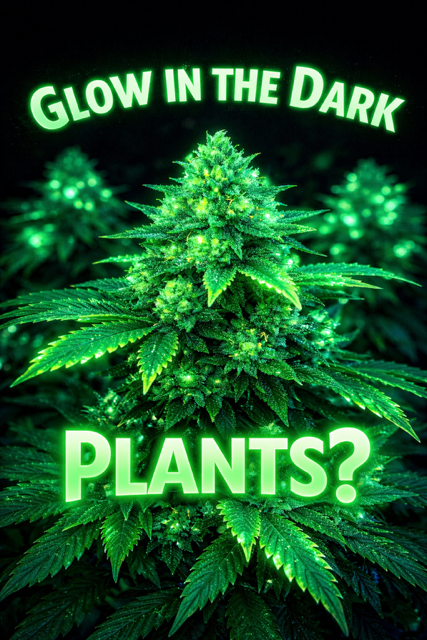
That’s why the image of glowing cannabis hits hard before anybody says a single technical word. The image already does the work. A glowing plant in a weed-adjacent imagination stops being just a plant. It turns into myth weed. Forbidden weed. Future weed. Sci-fi weed. Poster weed. Rumor weed. The kind of image that makes people start inventing stories, memes, merch, and terrible startup ideas before midnight.
That is cannabis culture being cannabis culture.
—
## Is this really about cannabis, or is it about vibe?
It’s about vibe first, and cannabis is a vibe-heavy culture.
That’s the truth.
People always try to shove cannabis into one lane. Drug. Medicine. Agriculture. Policy. Business. Fine. Those are all real. But weed has always been bigger than that. It has visual gravity. It has theater. It has symbolism. It has subculture. It has that ability to take one image and turn it into a whole fucking mood.
That is exactly what happens here.
The second the public sees a real glowing flower, the weed half of the population does not go, “Interesting ornamental biotech development.” The weed half starts thinking about posters, shirts, memes, rumors, branding, somebody bullshitting about glowing cannabis, somebody else starting a hemp brand with some glowing leaf logo by Friday. That is not operational guidance. That is just cultural gravity. That’s where the mind goes because that’s where the culture already lives.
—
## Are people already imagining future glowing cannabis cultivars?
Fuck yes they are.
You show people real glowing plants and they are not gonna stop at, “wow, neat petunia.” Their brains go straight to the deep end. They start imagining whole future lineups of glowing plant cultivars, collector plants, show plants, rumor plants, and somewhere in that fantasy cloud, glowing cannabis cultivars hanging there like forbidden sci-fi fruit.
That does not require a manual.
It just requires an imagination.
And cannabis culture has never exactly suffered from a lack of imagination. The second a new visual superpower hits the plant world, weed people start projecting it onto the future. That part is automatic. At first it’s a joke. Then it’s on a poster. Then it turns into a rumor. Then it starts becoming part of the mythology.
That’s how these ideas move.
They don’t arrive politely. They spread sideways. People laugh at them first, then they like the picture, then they start repeating it, and before long it has a weird kind of reality just because everybody can see it in their heads.
—