High Temp vs Low Temp Dabs: What’s Actually Better?
Let’s talk about one of the biggest arguments in dab culture—high temp vs low temp.
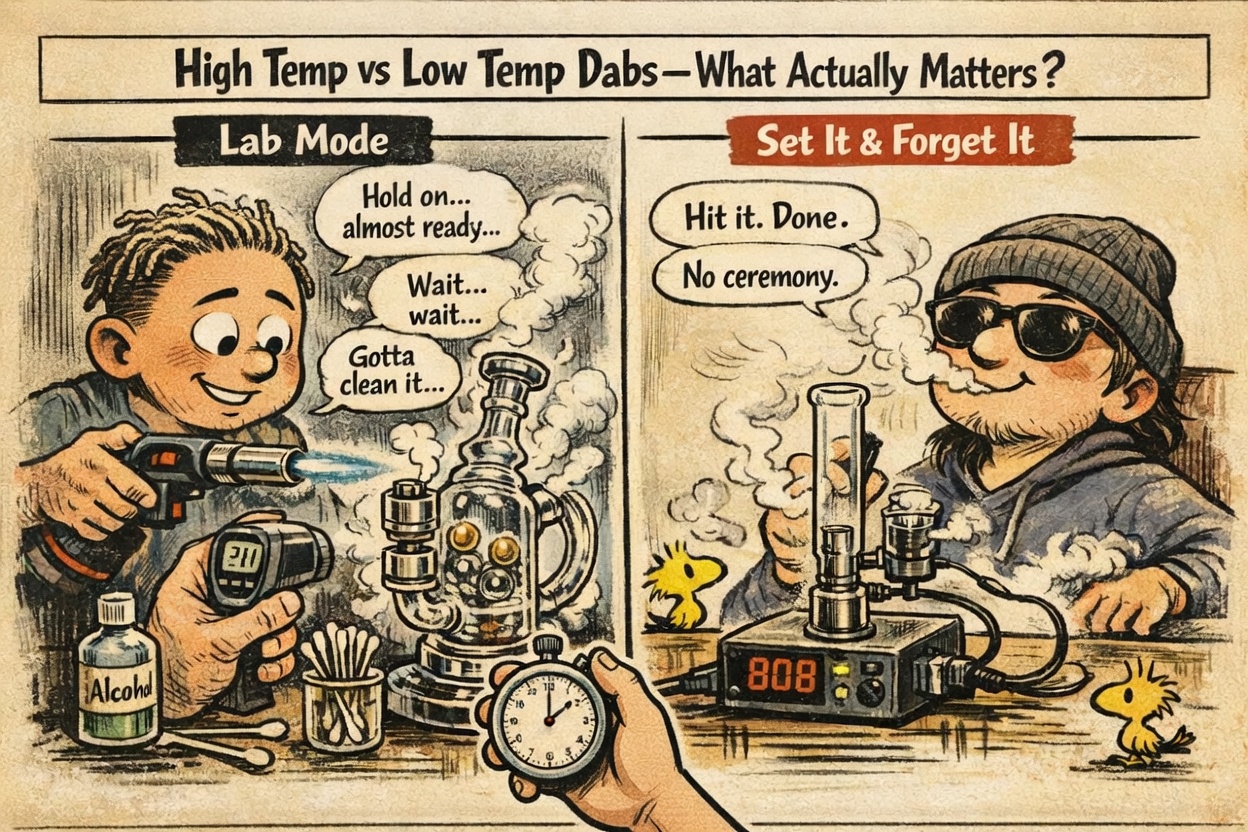
If you hang around long enough, you’ll see it play out the same way every time. There’s always that guy with the quartz bucket, the carb cap, the little spinning pearls doing gymnastics in the banger, and a torch that sounds like he’s welding a submarine. Sometimes there’s even a laser thermometer involved, like we’re about to land a spacecraft instead of take a dab.
He heats it, waits, watches the clock, spins the pearls, caps it, hits it, and then evaluates the whole thing like he’s judging a wine competition. And look, no disrespect—that setup works. You can absolutely get smooth, flavorful hits that way, and there’s a reason people swear by it.
But at some point, you’ve got to step back and ask yourself a simple question: are we smoking weed, or are we running a lab experiment?
Because on the other side of all that, there’s a completely different approach. No stopwatch, no pearls doing gymnastics, no countdown. The heat is already there, the dab goes on, and you hit it. Maybe one pull, maybe two, and you’re done. Simple, efficient, no ceremony.
And somehow, according to the internet, that second way is supposed to be the “bad” one—too hot, too harsh, burning everything up, destroying terpenes, basically turning your dab into some kind of chemical disaster.
The problem is, that whole argument only makes sense if temperature is the only thing that matters. And it isn’t.
So what’s actually different between these setups?
When you strip away all the accessories, both methods are doing the exact same job. They’re taking a concentrate—solid or liquid—and turning it into vapor so you can inhale it. Same goal, same outcome.
The low-temp quartz setup is all about control. You heat it up, let it cool into a specific range, then trap the vapor with a carb cap so it doesn’t escape. The pearls move the oil around so it vaporizes evenly, and the restricted airflow builds pressure so you can get thick vapor at lower temperatures. It’s efficient, controlled, and very deliberate.
The higher-temperature e-nail or titanium setup works differently. Instead of carefully dialing everything into a narrow window, it uses constant heat and open airflow. There’s no cap holding vapor in, no pressure system helping things along, so instead of relying on efficiency, it relies on heat to get the job done.
That’s why people call one “low temp” and the other “high temp,” but those labels don’t really tell the whole story, because what actually happens during the hit is a lot more dynamic than that.
What’s really happening when you take a dab?
Most people think they’re taking a dab at a fixed temperature. If the dial says a high number, they assume they’re hitting that exact number, and if someone says a lower range is ideal, they imagine everything is happening right there.
That’s not how it works in practice.
The moment you take a dab, everything starts changing. The oil hits the hot surface and immediately pulls heat out of it. At the same time, you’re pulling air through the rig, which cools the surface even further. As vapor forms and starts moving, it cools again, while the heating element is trying to bring the temperature back up.
So instead of a fixed number, what you really have is a moving system. The temperature is constantly dropping, recovering, and shifting throughout the hit, which means you’re not hitting a number—you’re riding a curve.
So is “high temp” really that high?
Let’s say you’re running a higher-temperature setup. That number is coming from the controller, not necessarily the exact surface where the dab is touching, and the metal doesn’t perfectly match the sensor to begin with. The second you introduce airflow and oil, the temperature drops anyway.
If you’re taking small dabs, placing them on an edge instead of letting them pool, and pulling air through right away, you’re cooling that surface even more while also moving the oil instead of letting it sit there and cook.
In real terms, that means even though you’re starting hot, the actual vaporization is happening across a lower, constantly shifting range during the hit. You’re initiating things in a hotter zone, but most of what you inhale is formed as that system cools down.
What about terpenes—are you destroying them?
This is the part people worry about the most. You’ll hear that higher temperatures “burn off” terpenes and turn them into nasty compounds, and if you cook them hard enough and long enough, that can absolutely happen. Anyone who’s ever overheated concentrates during processing (fractional distillation) knows exactly what that smells like, and it’s not subtle.
But the missing piece in that conversation is time.
It’s not just temperature that matters—it’s how long the material sits at that temperature. If oil pools up and bakes on a hot surface, that’s when you start getting that overcooked, harsh profile. If you’re working with small amounts, spreading it thin, and pulling vapor off immediately, you’re not giving it much time to degrade.
So even if you’re starting hotter than a low-temp quartz setup, you’re also reducing how long those compounds stay in that environment, and that changes the outcome more than most people realize.
If your hits taste clean and consistent, that’s usually a pretty reliable signal that you’re not pushing things into that overcooked zone.
And then there’s the cleaning ritual…
This part is just funny once you notice it.
If you’ve ever watched a low-temp setup in action, you already know what happens after every single hit. Out comes the alcohol, out comes the Q-tip, and suddenly the whole thing turns into what looks like a sterile lab procedure. Swab the bucket, rotate the Q-tip, make sure there’s no residue, no contamination, nothing left behind.
At some point it starts to feel less like smoking weed and more like someone’s doing tissue culture in a clean room.
Again, nothing wrong with it. It keeps things clean and consistent, and if that’s your thing, go for it. But it is a whole process.
Meanwhile, on the other side, you’ve got a chunk of titanium sitting there at a few hundred degrees. Whatever lands on it isn’t exactly setting up camp and growing anything, and there’s not much to baby between hits. It’s just a different level of maintenance altogether.
So what’s actually better?
At the end of the day, this isn’t really a right-versus-wrong situation.
The low-temp setup is more controlled, more precise, and probably does preserve a bit more of the delicate terpene profile. If you’re chasing flavor at the highest level, that system is built for it.
But here’s the honest question: can you actually tell the difference?
If you took the vapor from both setups and put them side by side, would most people—really most people—consistently be able to pick one over the other? There are definitely folks out there who treat cannabis like wine, picking up subtle differences and breaking things down in detail. We probably need a better word for them—something like “terpologists” or “flavornauts”—because they’re operating on another level.
For everyone else, though, you’re getting a strong, clean hit either way. One just comes with a little more ceremony.
Final thought
At the end of the day, you’re not chasing a number—you’re working with a process. Heat, airflow, material, and timing all interact in real time every time you take a hit, and once you understand that, the whole high-temp versus low-temp debate starts to look less like a strict rule and more like a matter of preference.
Whether you’re running a full lab-style setup with pearls spinning around or just heating it, hitting it, and moving on, the goal is the same. Take the hit, enjoy it, and don’t overthink it too much—unless you want to.