REGULATION AS SABOTAGE
THE WAR ON WEED, THE RŌNIN, AND THE LIES STILL WALKING AROUND
Why is cannabis regulation not just paperwork, but a continuation of the War on Weed?
The financial engine behind it was staggering. The United States has spent over a trillion dollars on the drug war since 1971 [3], and law enforcement learned quickly that cannabis arrests weren’t just low-risk work — they were a renewable revenue stream.
Cannabis regulation is not neutral administration; it is the War on Weed wearing a new mask. Anyone who lived through the last fifty years knows this wasn’t a metaphorical conflict — it was a real goddamn war. Millions were arrested — more than eight million between 2001 and 2010 alone [1], and another 6.1 million from 2010 to 2018 [2]. Families were uprooted, futures destroyed, wealth stripped, and entire communities hammered so cops, courts, and agencies could pad statistics and budgets.
What changed after legalization — and what didn’t?
The culture moved, the science moved, and the voters moved. Hemp and CBD went mainstream, legal markets spread, and THC drinks landed on grocery shelves. The war was effectively over.
What did not change was the behavior of the people who fought on the losing side. They never put down the sword — they simply changed their justification. To understand why, you have to look at history.
Who are the “prohibition rōnin,” and why are they still fighting?
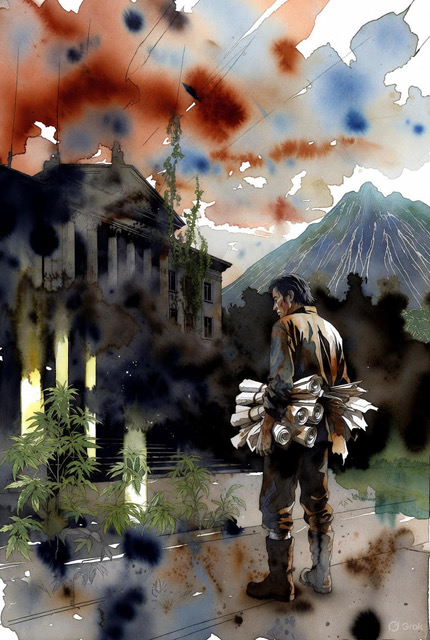
Prohibition rōnin are the institutional survivors of the drug war — cops, prosecutors, judges, and agencies trained for conflict who lost their battlefield. In feudal Japan, samurai who lost their lords didn’t become farmers; they became rōnin — still armed, still trained, still wired for war.
That is exactly what happened after prohibition collapsed. The fighters didn’t disappear. They migrated into “regulation,” “public safety,” and “intoxication law,” swinging the same sword with new excuses.
Is “protecting the children” a real justification for cannabis regulation?
No — it is one of the most durable lies left in the arsenal. The medicine-cabinet test exposes it instantly. Every kid eventually opens the cabinet. Inside are opioids, benzodiazepines, antidepressants, blood-pressure meds, antibiotics, and sleeping pills — any of which can seriously harm or kill a child.
And then there’s cannabis. Ask any honest parent which substance they would choose if they had no control, and they point to cannabis every time — not because they want their kid high, but because it is the safest substance in the entire cabinet.
Did youth cannabis use increase after legalization?
No — it declined. National CDC surveys show that current teen marijuana use fell from 23.1% to 15.8% between 2011 and 2021 [4], and early first-use dropped from 8.1% to 4.9% [5]. Monitoring the Future data show record shares of 8th, 10th, and 12th graders reporting zero alcohol, tobacco, or cannabis use in the past 30 days [6].
Teen use didn’t rise with legalization. It fell. Lawmakers know this. They simply pretend not to.
Is cannabis intoxication comparable to alcohol impairment?
No — cannabis does not have a clean impairment curve the way alcohol does. THC blood levels do not map reliably to impairment, and frequent users test positive long after any high has faded.
NHTSA’s own case-controlled crash study found that THC alone was not associated with increased crash risk once age and sex were controlled for [7]. Yet prohibition rōnin weaponize THC detection as if it proves impairment.
Why do THC crash statistics mislead the public?
Because they measure detection, not impairment, fault, or timing. Fatal crashes with THC-positive drivers rose from 9% in 2000 to over 21% by 2018 [8], and Washington State reported 21% THC-positive in fatal crashes in 2017 [9].
What these numbers don’t show is whether THC caused the crash, whether alcohol was also present, or whether the THC was consumed days earlier. Many THC-positive drivers were victims, not causes. But THC-positive equals revenue, and revenue lost to legalization had to be replaced.
Why is the “plain smell” doctrine collapsing in court?
Because legalization and hemp made it legally and scientifically indefensible. For decades, “I smell marijuana” was enough to erase the Fourth Amendment. That era is ending.
Florida’s 2025 *Williams v. State* decision ruled that odor alone is no longer probable cause [10]. The Michigan Supreme Court reached the same conclusion [11], as did courts in Illinois and New Jersey [12]. States that cling to smell-based searches are exhibiting classic rōnin behavior — fighting a war that no longer exists.
How does civil asset forfeiture drive continued cannabis enforcement?
Civil forfeiture is the financial backbone of prohibition. In some jurisdictions, forfeiture accounts for over 20% of police budgets [13], and certain counties pull in roughly $1 million per year from highway stops where no one is ever charged [14].
Cannabis cases fed this system for decades. Legalization weakened it, but didn’t kill it. So the system adapted again: regulate hemp to death, tighten DUI laws, weaponize zoning, bury farmers in paperwork, and resurrect prohibition under the label of “regulation.”
Why does cannabis regulation still function as sabotage?
Because the same institutions that lost the war are still embedded in enforcement, unions, lobbies, and regulatory bodies. They are not trying to protect public safety — they are trying to recreate a battlefield they depended on.
Until those incentives are dismantled, prohibition rōnin will continue swinging the sword at growers, patients, and anyone in reach.
What must change to actually finish the War on Weed?
Finishing the job means eliminating THC per-se limits based on bad science, ending civil asset forfeiture that rewards policing for profit, forcing universal recognition that odor alone is not probable cause, protecting hemp farmers from federal sabotage like Section 781, and exposing every false narrative dressed up as safety.
The war is over. They lost. But like soldiers still fighting in the jungle long after the treaty, prohibition rōnin keep swinging. Our job is to make sure there’s nowhere left for them to hide.